

What should you check when reviewing PDB structures for cancer genes before sharing them with stakeholders?
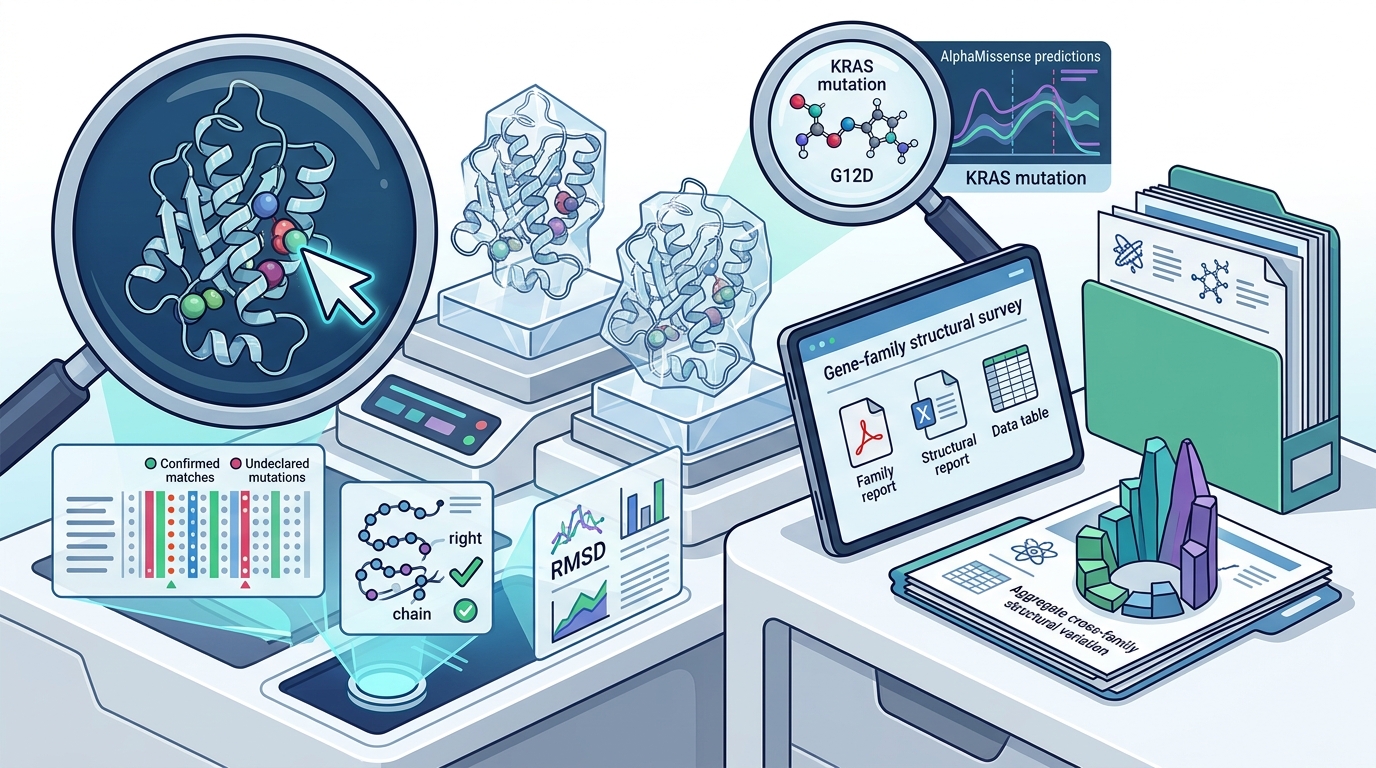
Before sharing PDB structures for cancer genes, verify the correct protein chain, confirm sequence identity against a reference, and audit mutation labels for undeclared differences. Morphogenesis Analytics provides a Protein Structure Analyzer that automates these checks, ensuring your structural data is accurate and stakeholder-ready.
Verify Chain and Domain Identity
Audit Sequence Identity and Undeclared Mutations
Sequence identity is the degree of match between the deposited sequence and a reference standard, such as the wild-type sequence from UniProt. Many PDB entries contain mutations that are not declared in the title or abstract. These undeclared mutations can significantly alter the structural geometry, leading to misinterpretation of the protein's native state. For instance, a structure labeled as wild-type KRAS might actually contain a silent mutation or a stabilizing mutation that changes the conformation of the switch regions. By comparing the deposited sequence to the reference, you can identify these discrepancies. This audit ensures that any structural differences you observe are due to the intended experimental conditions, not hidden sequence variations. For additional details, review the Frequently Asked Questions.
Distinguish Evidence Layers
Handle Missing Data and Experimental Features
Prepare Stakeholder-Ready Reports
Key Takeaways
- Verify the correct protein chain and domain to avoid analyzing the wrong biological entity. For additional details, review the About.
- Audit sequence identity to identify undeclared mutations that may affect structural geometry.
- Distinguish between geometric differences, sequence changes, and pathogenicity annotations.
- Interpret missing data as unresolved regions, not as functional defects or mutations.
Frequently Asked Questions
What is the first thing to check in a PDB structure?
The first thing to check is the chain and domain identity to ensure you are analyzing the correct protein isoform.
Why are undeclared mutations a problem?
Undeclared mutations can alter the structural geometry, leading to misinterpretation of the protein's native state.
Does structural distance imply biological function?
No, structural distance describes geometric difference, not biological function, mutation impact, or pathogenicity.
What should I do if a region has missing density?
Mark the region as unresolved and do not interpret the missing data as a mutation or functional defect.
Can I use experimental features for drug discovery?
Experimental features, such as Void Shell, have not passed validation and should not be used to identify drug-binding sites.
Is this analysis suitable for clinical diagnosis?
No, this analysis is for research use only and is not a medical device or clinical diagnostic. according to Systematic analysis of