

Hidden mutations in PDB structures are sequence differences between a deposited protein model and its reference sequence that are not declared in the entry's title or mutation labels. These discrepancies can silently alter structural analyses, leading to false conclusions about conformational changes or binding sites. Morphogenesis Analytics provides a structure identity and label audit that flags these undeclared differences with residue-level evidence, ensuring your structural data is accurate before you draw conclusions. For additional details, review the .
Why PDB Labels Are Not Reliable
Protein Data Bank (PDB) entries often contain metadata that does not perfectly match the atomic coordinates. The deposited mutation labels are manually curated and can be incomplete or incorrect. A structure may be labeled as wild-type, yet the coordinates reflect a mutant construct. This mismatch is a common source of error in structural biology pipelines. When you compare two structures, you are comparing the atoms, not the labels. If the labels are wrong, your comparison is built on a false premise. For additional details, review the Frequently Asked Questions.
How to Detect Undeclared Mutations
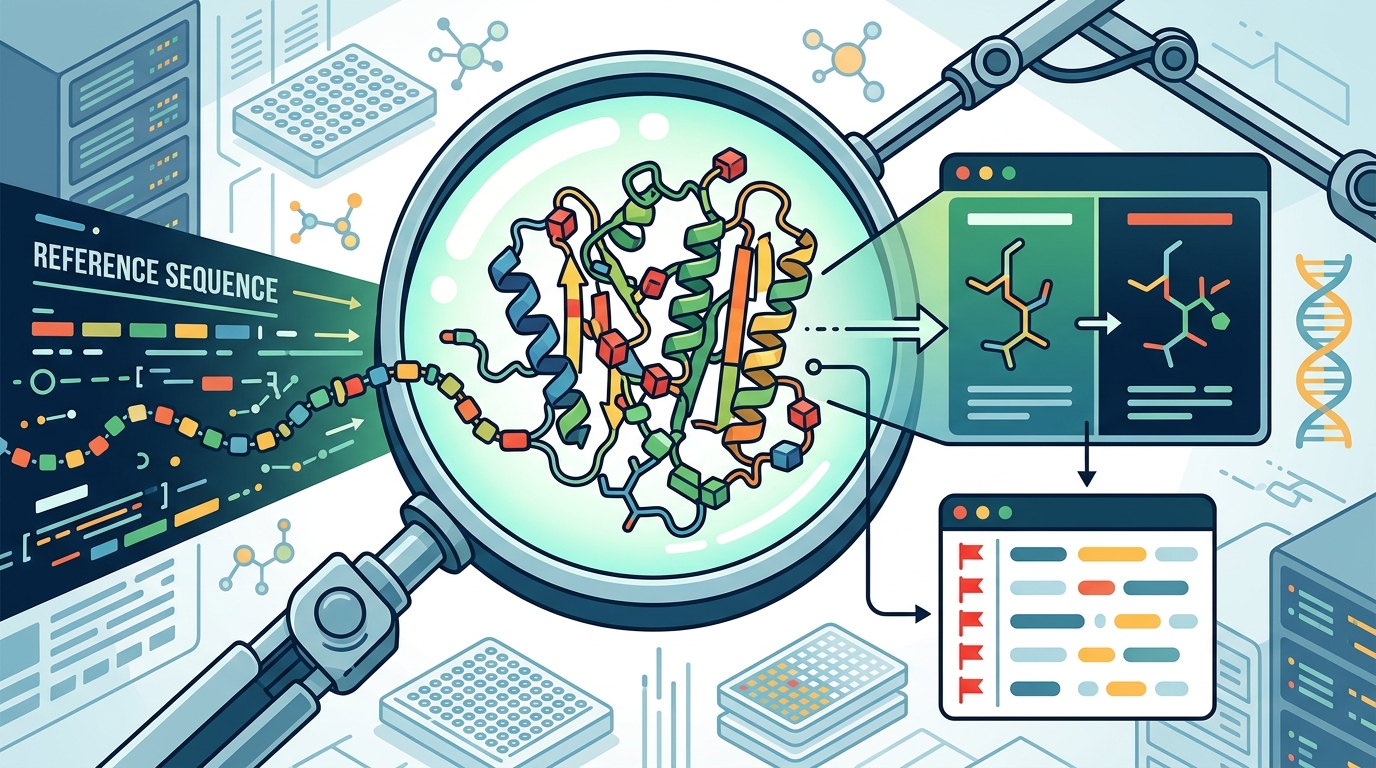
Detecting hidden mutations requires a rigorous comparison of the deposited sequence against a trusted reference. This process involves aligning the sequence of the PDB entry to the reference protein and identifying all residue substitutions. Morphogenesis Analytics automates this by checking every matching deposited structure against the reference. The platform separates true comparable mutants from same-sequence copies and wrong domains. This ensures that only valid structural differences are analyzed. The output is a flagged CSV with residue-level evidence, allowing you to verify each discrepancy. For additional details, review the About.
Impact on Structural Analysis
Undeclared mutations can significantly impact structural comparisons. A single amino acid substitution can alter the local geometry of a protein, changing the apparent conformational state. If this mutation is not accounted for, you may misinterpret a structural difference as a functional change. For example, a mutation in a flexible loop might cause a shift in the loop's position, which could be mistaken for a binding-induced conformational change. By identifying these hidden mutations, you can distinguish between true structural dynamics and artifacts of the construct.
Case Study: Choline Acetyltransferase
Consider the case of choline acetyltransferase, an enzyme involved in motor disorders. Research has shown that while half of the mutations that cause motor disorders are positioned to affect enzyme activity directly, the remaining changes are surprisingly distant from the active site and must exert indirect effects, as noted in a study published in PMC. If these distant mutations are not declared in the PDB labels, a structural comparison might incorrectly attribute the observed changes to the active site. This highlights the importance of verifying mutation labels before performing any structural analysis.
Key Takeaways
- PDB labels are manually curated and can be incomplete or incorrect.
- Hidden mutations are sequence differences not declared in the entry's metadata.
- Undeclared mutations can lead to false conclusions in structural comparisons.
- Morphogenesis Analytics provides a structure identity and label audit to flag these discrepancies.
- The audit delivers a flagged CSV with residue-level evidence for verification.
- Always verify mutation labels against the original deposition before concluding an entry is wrong.
Frequently Asked Questions
What is a hidden mutation in a PDB structure?
A hidden mutation is a sequence difference between a deposited protein model and its reference sequence that is not declared in the entry's title or mutation labels.
Why are PDB labels unreliable?
PDB labels are manually curated and can be incomplete or incorrect, leading to mismatches between the metadata and the atomic coordinates.
How does Morphogenesis Analytics detect hidden mutations?
Morphogenesis Analytics detects hidden mutations by comparing the deposited sequence against a trusted reference and flagging all residue substitutions with residue-level evidence.
What is the impact of hidden mutations on structural analysis?
Hidden mutations can alter the local geometry of a protein, leading to false conclusions about conformational changes or binding sites.
Can hidden mutations be found in wild-type structures?
Yes, a structure labeled as wild-type may contain undeclared mutations, which can be detected through a rigorous sequence comparison.
How do I verify a flagged mutation?
You should check the flagged label discrepancy against the original deposition before concluding the entry is wrong.
Conclusion
Hidden mutations in PDB structures are a significant source of error in structural biology. By using a structure identity and label audit, you can ensure that your structural data is accurate and reliable. Morphogenesis Analytics provides the tools you need to detect and verify these discrepancies, allowing you to draw confident conclusions from your structural analyses. To plan your visit, .