

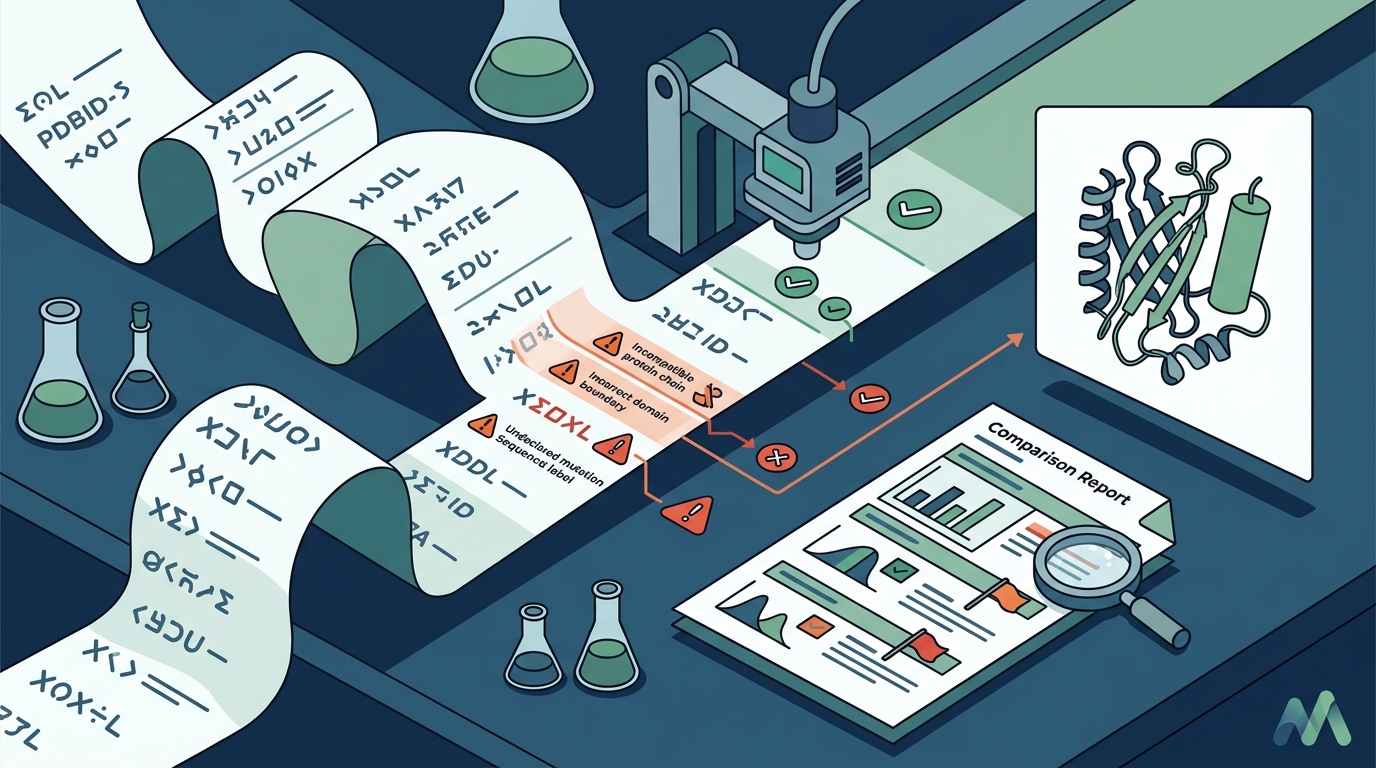
Yes, you can check a list of PDB IDs to identify entries that do not match your target protein. Morphogenesis Analytics provides a structure identity and label audit that flags incorrect chains, domains, and undeclared mutations. This guide covers how to verify protein identity, validate structural data, and compare sequences to ensure your structural biology dataset is accurate. For additional details, review the .
PDB ID Verification
Protein Data Bank (PDB) entries are the standard for structural biology data. However, a PDB ID does not guarantee that the deposited structure matches the biological target you expect. The Protein Data Bank contains millions of entries, and metadata errors or mislabeled chains can occur. Verification is the first step in ensuring data integrity. For additional details, review the Customer Experience.
Why Verification Matters
Researchers often assume that a PDB ID corresponds to a specific protein and mutation state. In reality, deposited structures may contain different chains, domains, or partner proteins. A structure identity audit checks the gene, chain, and domain against your expected target. This process identifies entries that are the wrong protein or contain sequence differences that their mutation labels do not declare. according to Protein Data Bank For additional details, review the Frequently Asked Questions.
The Audit Process
Morphogenesis Analytics delivers a flagged CSV with residue-level evidence. This report highlights discrepancies between the deposited metadata and the actual structural data. By automating this check, researchers can quickly filter out invalid entries from their datasets. This is critical for downstream analyses such as drug binding site identification or evolutionary studies. For additional details, review the About.
Protein Identity Validation
Protein identity validation is the process of confirming that a structural model represents the correct biological entity. This goes beyond simple name matching. It involves checking the sequence, the domain architecture, and the conformational state. Validation ensures that the structure is suitable for the specific scientific question being asked.
Chain and Domain Checks
Mutation Label Accuracy
Mutation labels in PDB files are often manually entered and can contain errors. A structural check compares the deposited mutation labels against the actual sequence differences. If a label declares a mutation that is not present in the sequence, or if a sequence difference is not labeled, the entry is flagged. This residue-level evidence allows researchers to trust the structural data or correct the metadata. according to IUCr Protein Data
Sequence Comparison
Sequence comparison is a fundamental technique in structural biology. It involves aligning the sequence of a deposited structure against a reference sequence. This alignment reveals insertions, deletions, and substitutions. These differences can indicate mutations, construct variations, or species differences.
Reference Selection
Choosing the correct reference sequence is crucial. The reference should represent the canonical form of the protein. For cancer genes, this might be the wild-type sequence. For drug-bound states, it might be a specific mutant. The comparison tool measures the structural distance from this reference. This distance describes geometric difference, not biological function. It is a metric of structural similarity, not pathogenicity.
Interpreting Differences
Sequence differences do not always mean the structure is wrong. They can arise from conformational state, construct design, or binding partners. For example, a protein might adopt a different fold when bound to a ligand. The comparison report separates true comparable mutants from same-sequence copies. This helps researchers understand the source of the structural variation.
Comparison Table: Verification Methods
| Method | Focus | Output | Use Case |
|---|---|---|---|
| Structure Identity Audit | Gene, chain, domain, mutation labels | Flagged CSV with residue evidence | Filtering PDB ID lists |
| Gene-Family Survey | All deposited structures for a gene | Family report PDF and data table | Cancer gene structural analysis |
| Pairwise Comparison | Two structures of the same protein | Comparison report with per-residue displacement | Mutant vs. wild-type analysis |
| Mutation Structural Check | Named substitution vs. deposited structures | Report with AlphaMissense layer | Specific mutation impact assessment |
Key Takeaways
- PDB IDs do not guarantee protein identity; verification is essential.
- Structure identity audits flag incorrect chains, domains, and undeclared mutations.
- Protein identity validation checks sequence, domain architecture, and conformational state.
- Sequence comparison reveals insertions, deletions, and substitutions relative to a reference.
- Structural distance describes geometric difference, not biological function or pathogenicity.
- Mutation labels in PDB files can be inaccurate; residue-level evidence is required for validation.
- Automated tools like Morphogenesis Analytics streamline the verification process for large datasets.
- Results are provided as is; users are responsible for independent verification.
Frequently Asked Questions
Can I check a list of PDB IDs for protein identity?
Yes. Morphogenesis Analytics offers a structure identity and label audit that takes a list of PDB IDs and flags entries that do not match the expected protein, chain, or domain. The output is a CSV file with residue-level evidence.
What does a flagged mutation label mean?
A flagged mutation label indicates a discrepancy between the deposited mutation label and the actual sequence differences. This could mean the label is incorrect, or that there are undeclared sequence variations. The report provides the residue-level evidence to help you investigate.
Does structural distance indicate pathogenicity?
No. Structural distance from a reference describes geometric difference. It does not indicate biological function, mutation impact, pathogenicity, cancer severity, or drug sensitivity. Differences can arise from conformational state, construct, ligands, or binding partners.
How is sequence comparison performed?
Sequence comparison involves aligning the sequence of a deposited structure against a reference sequence. This alignment reveals insertions, deletions, and substitutions. The tool separates true comparable mutants from same-sequence copies to help interpret the results.
Can I compare two structures of the same protein?
Is the tool a medical device?
No. Morphogenesis Analytics provides computational analysis of publicly deposited protein structures. It is not a medical device or clinical diagnostic and must not be used for patient care decisions.
What is the difference between geometry and sequence identity?
Geometry refers to the three-dimensional arrangement of atoms in the structure. Sequence identity refers to the match between the amino acid sequence of the structure and a reference sequence. These are distinct kinds of evidence and are reported separately. according to IUCr Protein Data
Are AlphaMissense scores generated by this platform?
No. AlphaMissense scores are third-party predictions and are not generated by this platform. They are shown alongside the structural data as a separate layer for reference.
Conclusion
Verifying PDB IDs is a critical step in structural biology research. By using tools like Morphogenesis Analytics, researchers can ensure that their datasets contain the correct proteins, chains, and domains. This guide has outlined the processes for PDB ID verification, protein identity validation, and sequence comparison. These methods help identify discrepancies and ensure data integrity. To start your analysis, visit the Protein Structure Analyzer and upload your list of PDB IDs for a comprehensive audit.