

Is There a Tool That Covers Deposited Structures Across Dozens of Cancer Gene Families?
Yes, Morphogenesis Analytics provides a specialized platform that audits deposited protein structures across multiple cancer gene families. It generates client-ready reports that separate true structural variants from sequence copies and wrong domains. This guide explains how to use structural data for research and what to expect from automated analysis. For additional details, review the .
Why Structural Audits Matter in Cancer Research
Cancer genomics has produced a massive amount of data, but raw sequence data often lacks the geometric context needed for drug design. A protein structure is a three-dimensional representation of a molecule that reveals how amino acids fold and interact. Without proper annotation, researchers may waste time analyzing structures that do not match the intended mutation or domain. Morphogenesis Analytics helps bridge this gap by providing rigorous identity checks and structural audits. according to Understanding oncogenicity of For additional details, review the About.
The Problem with Raw Data
Public databases contain thousands of entries, but not all are equally useful. Some entries are duplicates, while others contain undeclared mutations. A structural audit is a systematic review of these entries to ensure they match their labels. This process is critical for any study that relies on structural data for hypothesis generation.
PDB Structure Annotation and Identity Verification
What the Audit Checks
The audit looks for several key issues. It verifies the protein identity by comparing the sequence to the reference. It checks the chain and domain assignments to ensure you are looking at the right part of the protein. It also detects undeclared mutations, which are sequence changes that are not listed in the PDB header. This level of detail is essential for avoiding errors in downstream analysis.
Gene-Family Structural Surveys
Deliverables and Use Cases
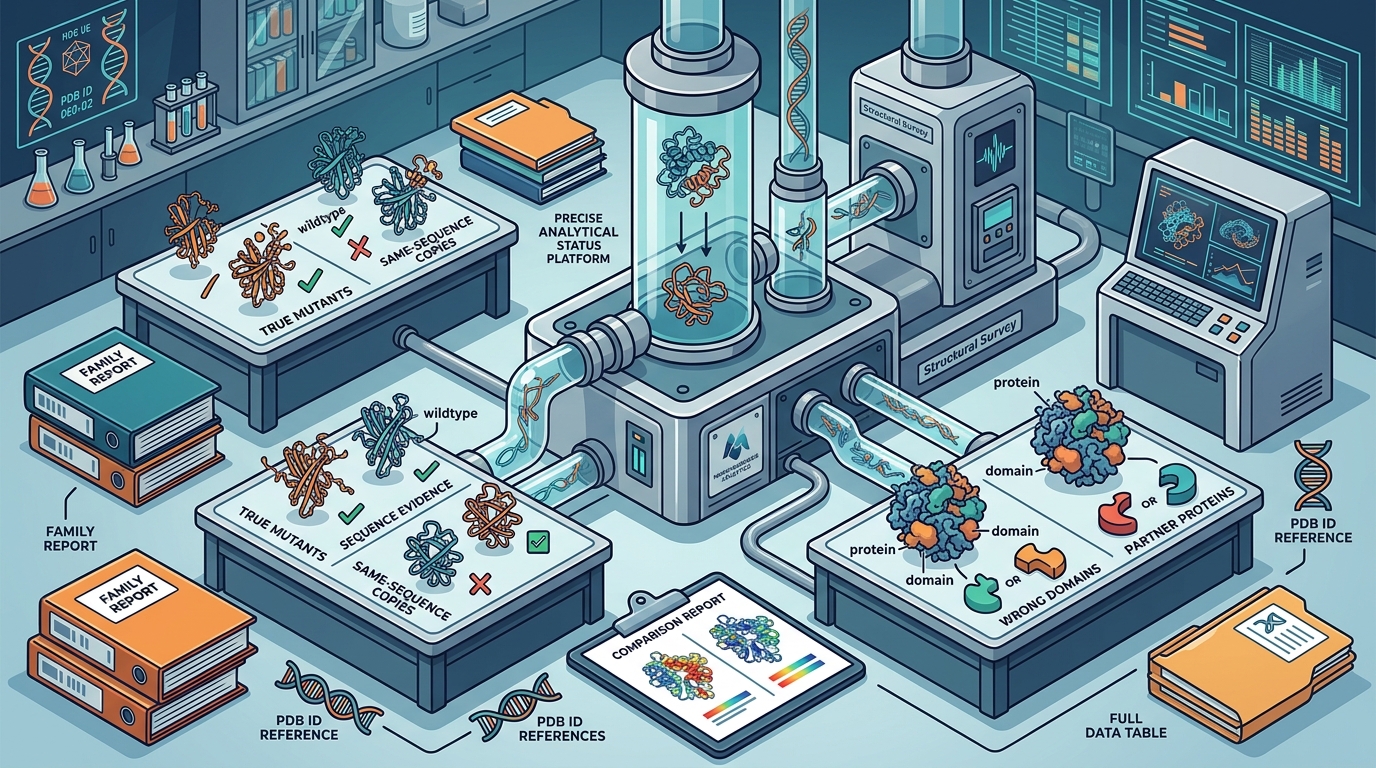
The family report provides a high-level summary of the structural landscape. The data table allows for deeper exploration of individual entries. This service is particularly useful for identifying gaps in structural coverage. It helps researchers decide which structures to prioritize for further study or drug design.
Pairwise Structure Comparison
When you have two structures of the same protein, such as a mutant and a wildtype, you need to compare them region by region. Morphogenesis Analytics provides a pairwise structure comparison tool. It calculates per-residue displacement, which is the distance each amino acid moves between the two structures. This allows you to see exactly where the mutation has an effect. The output is a detailed comparison report.
Interpreting Displacement
Per-residue displacement is a geometric measure. It tells you how much the structure has changed, but it does not tell you why. A large displacement might indicate a functional change, or it might just be a difference in conformational state. It is important to interpret these results in the context of the specific biological question.
Mutation Structural Checks
Separating Evidence Layers
It is crucial to understand that geometry, sequence identity, and pathogenicity annotations are distinct kinds of evidence. The platform reports them separately to avoid confusion. A high AlphaMissense score does not mean the structure is wrong, and a small structural change does not mean the mutation is benign. Each layer provides a different piece of the puzzle.
Predicted-Model Cleanup
Why Cleanup is Needed
Predicted models are not experimental structures. They are generated by algorithms that may introduce small errors. Regularization helps to smooth out these errors and produce a more realistic structure. This step is important for ensuring that downstream analyses are based on a reliable geometric foundation. according to Sleeping Beauty transposon
Cross-Family Comparison
Aggregate Insights
The cross-family report provides a summary of structural diversity. It highlights which families have the most variation and which are more conserved. This information can guide the selection of targets for drug development. It also helps in understanding the evolutionary constraints on these proteins.
Key Takeaways
- Morphogenesis Analytics provides a platform for auditing deposited protein structures across cancer gene families.
- The structure identity audit flags undeclared mutations and wrong domains, ensuring data integrity.
- Gene-family surveys separate true mutants from copies and partners, providing a clear structural landscape.
- Pairwise comparisons calculate per-residue displacement to show the geometric impact of mutations.
- Predicted-model cleanup refines AlphaFold models for better downstream analysis.
- Cross-family comparisons reveal patterns in structural variation across different cancer genes.
- All results are for research use only and do not constitute clinical diagnostic advice. according to Locus Specific Databases
Frequently Asked Questions
What is a structural audit?
A structural audit is a systematic review of deposited protein structures to verify their identity and label accuracy. It checks for undeclared mutations and wrong domain assignments.
Can I use the reports for client presentations?
Yes, the platform generates client-ready reports in PDF and CSV formats. These reports are designed to be clear and easy to understand for non-specialists.
Does the platform predict drug binding sites?
No, the platform does not predict drug binding sites. Modules marked experimental, such as Void Shell, have not passed validation and should not be used for this purpose.
What is per-residue displacement?
Per-residue displacement is a measure of how far each amino acid moves between two structures. It is a geometric metric that shows the extent of structural change.
Are AlphaMissense scores generated by Morphogenesis Analytics?
No, AlphaMissense scores are third-party predictions. They are included as a separate layer to provide additional context, but they are not generated by the platform.
Is the platform a medical device?
No, Morphogenesis Analytics is not a medical device or clinical diagnostic. It is a research tool for analyzing publicly deposited protein structures. according to Informatics Tools for
What happens if a structure has missing data?
Absent data or missing density is not a negative finding. It simply means that information is not available. The platform flags these gaps so you can be aware of them.
Conclusion
Morphogenesis Analytics provides a powerful set of tools for researchers working with cancer gene structures. From identity audits to cross-family comparisons, the platform ensures that your structural data is accurate and well-annotated. If you are looking for a tool that covers deposited structures across dozens of cancer gene families, this is the solution. Visit the Protein Structure Analyzer to start your analysis today. according to Comparison of Fresh