

Protein Data Bank (PDB) entries can contain mislabeled chains, incorrect residue sequences, or undeclared mutations. Morphogenesis Analytics provides a computational framework to audit these structural records against deposited metadata. This guide explains how to verify structural identity, sequence alignment, and mutation labels using automated validation tools and manual inspection techniques. For additional details, review the Protein Structure Analyzer.
WWPDB Validation Reports
The Worldwide Protein Data Bank (wwPDB) validation report is the primary quality control document for every deposited structure. It is a standardized PDF that summarizes geometric quality, sequence identity, and experimental metadata. Researchers should treat this report as the first checkpoint in any structural audit. For additional details, review the .
Understanding the Validation Metrics
Automated Identity Audits
Morphogenesis Analytics automates the identity audit process. The platform takes a list of PDB IDs and compares the deposited sequence against a reference sequence. It flags entries where the sequence identity is lower than expected or where mutation labels do not match the actual residue differences. This process delivers a flagged CSV with residue-level evidence, allowing researchers to quickly identify problematic entries. For additional details, review the Customer Experience.
Residue Sequence Labeling
Residue sequence labeling is the process of verifying that the amino acid sequence in a PDB file matches the intended biological construct. This is critical for cancer research, where specific mutations like KRAS G12D define the protein's behavior. Incorrect labeling can lead to false conclusions about drug binding or protein function. For additional details, review the Frequently Asked Questions.
Sequence Identity vs. Mutation Labels
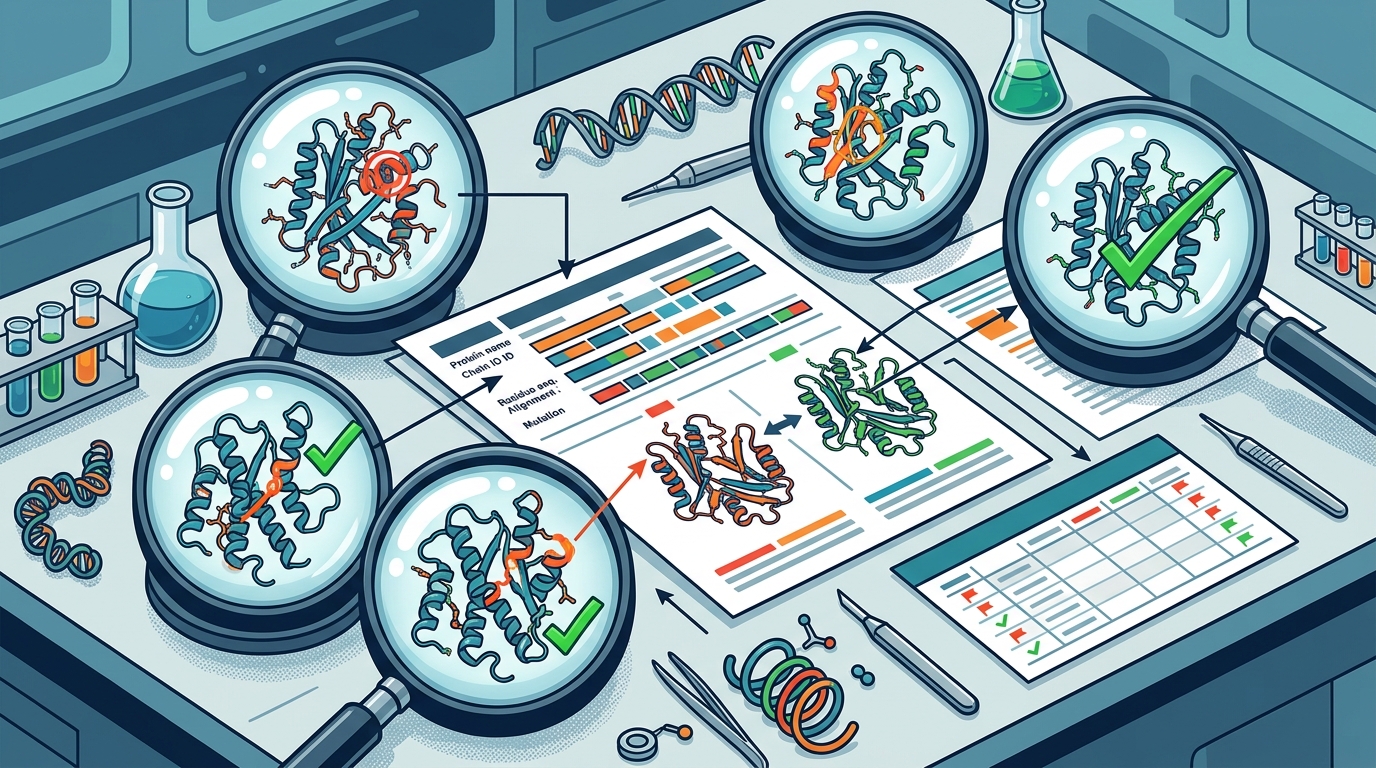
Sequence identity is the percentage of matching residues between two sequences. Mutation labels are the specific substitutions declared in the PDB header or associated metadata. A common error occurs when a structure is labeled as a mutant, but the deposited sequence is actually the wildtype. Conversely, a structure may contain a mutation that is not declared in the label. Morphogenesis Analytics separates these two evidence layers, reporting geometry, sequence identity, and deposited labels distinctly. For additional details, review the About.
Handling Undeclared Mutations
Undeclared mutations are a significant source of error in structural biology. When a structure is deposited, the authors may omit a mutation that was present in the construct. Automated tools can detect these discrepancies by aligning the deposited sequence to a reference. If a difference is found but not listed in the mutation labels, the tool flags it for manual review. This ensures that researchers are aware of all sequence variations before using the structure for analysis.
Key Takeaways
- wwPDB validation reports check geometric quality but do not verify sequence identity or mutation labels.
- Residue sequence labeling errors are common in cancer gene structures, particularly with KRAS and other oncogenes.
- Automated tools like Morphogenesis Analytics can flag undeclared mutations and mislabeled chains.
- Sequence identity and mutation labels are distinct evidence layers that must be reported separately.
- Missing data or undeclared mutations are not negative findings; they require manual verification against original deposition data.
- Structural distance from a reference describes geometric difference, not biological function or pathogenicity.
- Always check the original deposition paper and PDB header before concluding an entry is wrong.
Frequently Asked Questions
What is a PDB structure label?
How do I check if a mutation is correctly labeled?
You can check mutation labels by aligning the deposited sequence to a reference sequence. Tools like Morphogenesis Analytics automate this process, flagging any discrepancies between the declared labels and the actual residue differences.
What is the difference between sequence identity and mutation labels?
Sequence identity is the percentage of matching residues between two sequences. Mutation labels are the specific substitutions declared in the metadata. They are distinct evidence layers and should be reported separately.
Can wwPDB validation reports detect mislabeled mutations?
No, wwPDB validation reports focus on geometric quality metrics like Ramachandran outliers. They do not verify whether the deposited sequence matches the intended biological construct or if mutations are correctly labeled.
What should I do if I find an undeclared mutation?
If you find an undeclared mutation, you should check the original deposition paper and PDB header. If the mutation is not mentioned, you may need to contact the authors or flag the entry for review. Automated tools can help identify these discrepancies.
Is structural distance a measure of biological function?
No, structural distance from a reference describes geometric difference, not biological function, mutation impact, or pathogenicity. Differences can arise from conformational state, construct, ligands, or binding partners.
Conclusion
Verifying PDB structure labels is a critical step in structural biology research. By combining wwPDB validation reports with automated sequence audits, researchers can ensure that their data is accurate and reliable. Morphogenesis Analytics provides the tools to perform these audits efficiently, delivering flagged CSVs and detailed reports that highlight potential labeling errors. Use these resources to maintain the integrity of your structural analyses.