

Verifying PDB IDs: A Guide to Protein Identity Validation
Yes, you can check a list of PDB IDs to identify entries that do not match your target protein. Morphogenesis Analytics provides a structure identity and label audit service that flags incorrect chains, domains, and undeclared sequence differences. This guide explains how to validate protein identity, compare sequences, and interpret structural data accurately for research purposes. according to RCSB Protein Data
PDB ID Verification
Protein Data Bank (PDB) ID verification is the process of confirming that a deposited 3D structure corresponds to the specific biological molecule intended by the researcher. The Protein Data Bank serves as the single worldwide repository for 3D structures of large biological molecules, including proteins and nucleic acids from all organisms. However, a PDB ID alone does not guarantee that the structure represents the correct protein, chain, or domain for your specific experimental context. For additional details, review the .
Why IDs Can Be Misleading
The Audit Process
Morphogenesis Analytics performs a structure identity and label audit by taking a gene name or a list of PDB IDs. The system identifies which entries are the correct protein, chain, and domain. It also detects sequence differences that the deposited mutation labels do not declare. The output is a flagged CSV file containing residue-level evidence for each discrepancy. This allows researchers to filter out incorrect entries before proceeding with downstream analysis. according to Protein Data Bank For additional details, review the Customer Experience.
Protein Identity Validation
Protein identity validation is the systematic assessment of whether a 3D structure matches a reference sequence and expected structural features. This goes beyond simple name matching. It involves comparing the deposited sequence against a canonical reference, such as UniProt, and verifying that the structural fold aligns with the expected domain architecture. For gene families, this process separates true comparable mutants from same-sequence copies, wrong domains, and partner proteins. For additional details, review the Frequently Asked Questions.
Gene-Family Structural Surveys
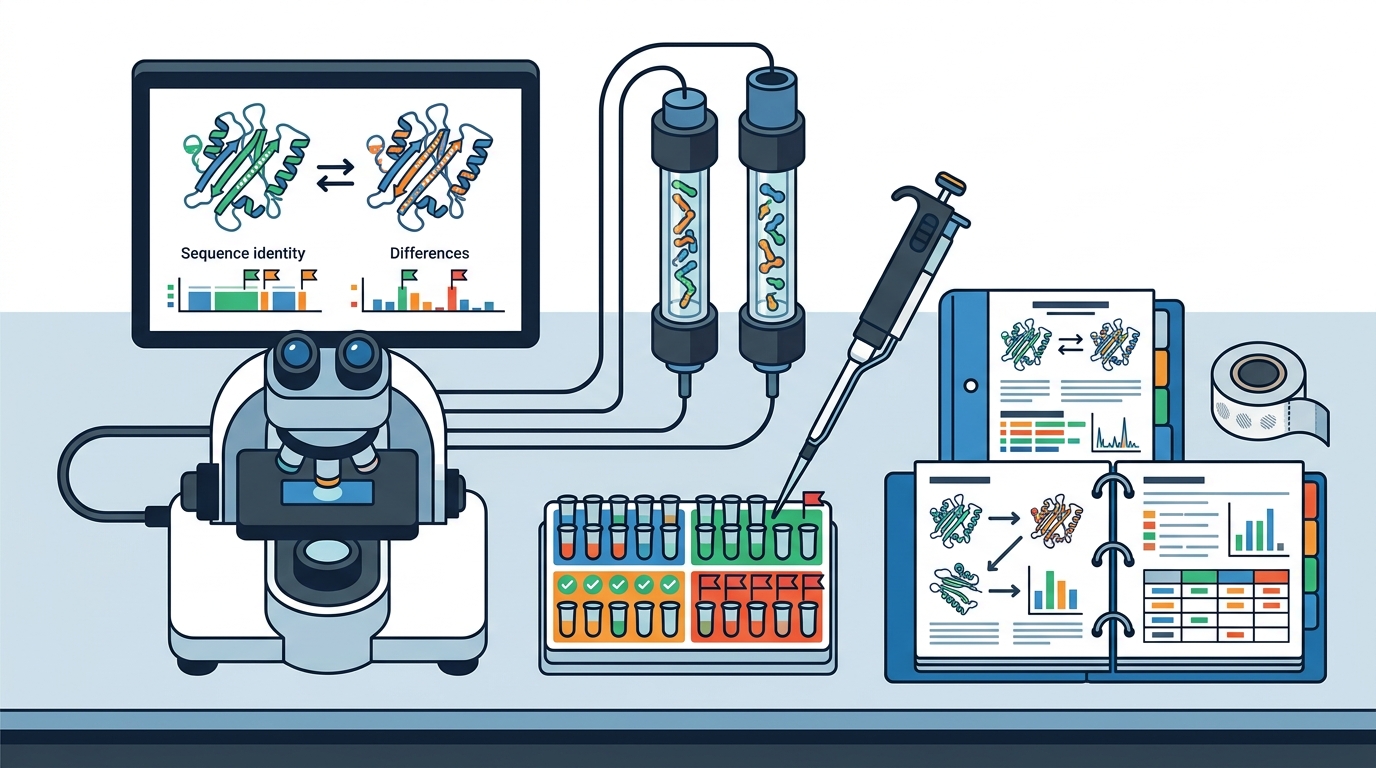
When analyzing a cancer gene, every deposited structure is measured against a reference sequence. The validation process distinguishes between genuine structural variants and artifacts. For example, a structure labeled as a mutant may actually be a wild-type copy or a different isoform entirely. Morphogenesis Analytics delivers a family report PDF and a full data table that details these distinctions. This ensures that only valid structures are included in comparative analyses.
Handling Complex Assemblies
Sequence Comparison
Sequence comparison is the alignment of a deposited protein sequence against a reference sequence to identify substitutions, insertions, and deletions. This is a foundational step in structural bioinformatics. While structural similarity can sometimes mask sequence differences, explicit sequence comparison provides definitive evidence of mutations. The comparison is performed at the residue level, allowing for precise mapping of changes to specific positions in the 3D structure.
Declared vs. Undeclared Mutations
A critical aspect of sequence comparison is identifying discrepancies between the deposited mutation labels and the actual sequence. A structure may be labeled with a specific mutation, but the sequence may show additional undeclared changes. Morphogenesis Analytics flags these discrepancies with residue-level evidence. This is essential for ensuring that the structural data accurately reflects the intended biological state. Undeclared mutations can significantly alter the interpretation of structural differences.
Integration with Predictive Models
Sequence comparison can be integrated with predictive tools like AlphaMissense. However, it is important to note that AlphaMissense scores are third-party predictions and are not generated by the Morphogenesis Analytics platform. They are shown alongside the structural data as a separate layer. This allows researchers to correlate sequence changes with predicted functional impacts while maintaining clear distinctions between observed geometry and predicted effects. according to RCSB Protein Data
Key Takeaways
- A PDB ID does not guarantee the correct protein, chain, or domain; verification is required.
- Structure identity audits flag incorrect entries and undeclared sequence differences with residue-level evidence.
- Protein identity validation separates true mutants from same-sequence copies and partner proteins.
- Sequence comparison identifies discrepancies between deposited labels and actual sequences.
- Structural distance describes geometric difference, not biological function or pathogenicity.
- AlphaMissense scores are third-party predictions and are reported separately from structural data.
- Missing data or undeclared mutations are not negative findings; they require independent verification.
- Results are provided for research use only and do not constitute clinical diagnostics. according to How to Read
Frequently Asked Questions
Can I check a list of PDB IDs for identity errors?
Yes. You can submit a list of PDB IDs or a gene name to Morphogenesis Analytics. The system will audit each entry to confirm the correct protein, chain, and domain, and flag any sequence differences not declared in the labels.
What is the difference between a PDB ID and a protein identity?
A PDB ID is a unique identifier for a deposited 3D structure. Protein identity refers to the specific biological molecule, chain, and domain represented in that structure. A single PDB ID may contain multiple proteins or incorrect chains, so identity validation is necessary.
How are undeclared mutations detected?
Undeclared mutations are detected by comparing the deposited sequence against the declared mutation labels and a reference sequence. Any discrepancies are flagged with residue-level evidence in the output CSV.
Does structural distance indicate biological function?
No. Structural distance from a reference describes geometric difference only. It does not indicate biological function, mutation impact, pathogenicity, cancer severity, or drug sensitivity. Differences can arise from conformational state, construct, ligands, or binding partners.
Are AlphaMissense scores generated by Morphogenesis Analytics?
No. AlphaMissense scores are third-party predictions. They are shown alongside the structural data as a separate layer but are not generated by the Morphogenesis Analytics platform.
Can I use these results for clinical decisions?
No. Morphogenesis Analytics provides computational analysis for research use only. It is not a medical device or clinical diagnostic and must not be used for patient care decisions.
What formats are the results delivered in?
Results are delivered as a flagged CSV with residue-level evidence for identity audits. For gene-family surveys, a family report PDF and a full data table are provided. Pairwise comparisons are delivered as a comparison report.
Conclusion
Verifying PDB IDs is a critical step in structural bioinformatics. By using Morphogenesis Analytics, researchers can ensure that their structural data is accurate and free from identity errors. The platform provides comprehensive audits, gene-family surveys, and sequence comparisons that deliver residue-level evidence for every discrepancy. This allows for confident downstream analysis and interpretation. To begin your structural verification, visit the Morphogenesis Analytics platform today. according to PDBrenum A webserver