

Verifying PDB IDs: A Guide to Protein Identity Validation
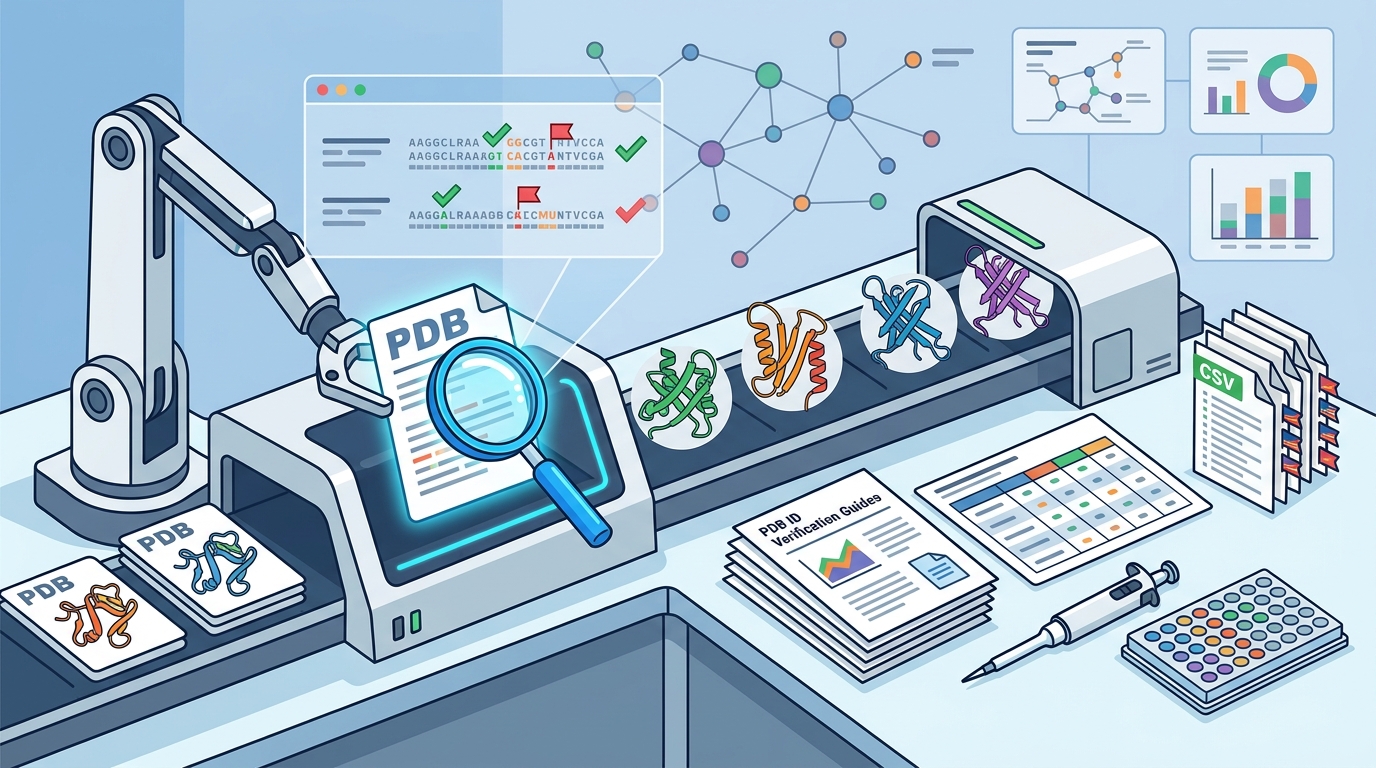
Yes, specialized computational tools can audit a list of PDB IDs to identify entries that do not match the expected protein, chain, or domain. Morphogenesis Analytics provides a structure identity and label audit service that flags sequence differences and undeclared mutations. This guide covers how to verify PDB IDs, validate protein identity, and perform sequence comparisons to ensure your structural data is accurate. For additional details, review the .
PDB ID Verification
The Risk of Misidentified Entries
Structural databases contain thousands of entries for popular cancer genes and signaling proteins. Many of these entries are depositions of the same protein in different conformational states, bound to different ligands, or containing mutations that are not explicitly declared in the title or abstract. If you use a list of PDB IDs for downstream analysis, such as docking or evolutionary studies, including an entry that is actually a different domain or a partner protein can skew your results. Verification is the first step in ensuring data integrity. For additional details, review the Customer Experience.
Automated Audit Processes
Protein Identity Validation
Protein identity validation is the process of confirming that a deposited structure corresponds to the specific biological entity intended by the researcher. This goes beyond simple name matching. It involves checking the chain composition, domain architecture, and the presence of specific residues. For gene families, such as those involved in cancer, the structural landscape is complex. A single gene may have multiple structures deposited, some of which are full-length proteins, while others are truncated constructs or isolated domains. according to IUCr Protein Data For additional details, review the Frequently Asked Questions.
Gene-Family Structural Surveys
When working with a cancer gene, it is crucial to distinguish between true comparable mutants and same-sequence copies. Morphogenesis Analytics provides a gene-family structural survey that measures every deposited structure for a gene against a reference. This survey separates true comparable mutants from same-sequence copies, wrong domains, and partner proteins. The result is a family report PDF and a full data table that helps you understand the structural diversity of the gene. This is particularly useful for researchers building datasets for machine learning or structural biology studies. For additional details, review the About.
Pairwise Structure Comparison
Once you have identified the correct entries, you may need to compare two structures of the same protein. This could be a mutant versus wild-type comparison, or two drug-bound states. Pairwise structure comparison allows you to analyze the differences region by region, with per-residue displacement metrics. This level of detail is essential for understanding how a mutation affects the protein's geometry. The comparison report provides a clear visual and numerical summary of the structural changes.
Sequence Comparison
Sequence comparison is a fundamental technique in structural biology. It involves aligning the amino acid sequences of two or more proteins to identify similarities and differences. In the context of PDB verification, sequence comparison helps to detect undeclared mutations. A structure may be labeled as wild-type, but the sequence may contain a substitution that was not mentioned in the deposition. By comparing the sequence of the PDB entry to a reference sequence, you can identify these discrepancies.
Mutation Structural Checks
A named substitution, such as KRAS G12D, can be checked against every matching deposited structure. Morphogenesis Analytics performs a mutation structural check that compares the named substitution to the actual sequence in the PDB entry. The service also shows AlphaMissense scores alongside as a separate layer. AlphaMissense is a third-party prediction tool that estimates the effect of a variant on protein function. By combining structural evidence with predicted functional impact, you get a more comprehensive view of the mutation. It is important to note that AlphaMissense scores are third-party predictions and are not generated by the Morphogenesis Analytics platform.
Sequence Identity and Geometry
Comparison of Verification Methods
| Method | Focus | Output | Best For |
|---|---|---|---|
| Structure Identity Audit | Label vs. Sequence | Flagged CSV | Filtering PDB lists |
| Gene-Family Survey according to General Social Survey | Reference vs. Deposits | PDF Report + Table | Cancer gene datasets |
| Pairwise Comparison | Region-by-Region | Comparison Report | Mutant vs. Wild-type |
| Mutation Check | Substitution vs. Structure | Report + AlphaMissense | Specific variant analysis |
Key Takeaways
- A valid PDB ID does not guarantee that the structure matches the expected protein or mutation state.
- Automated audits can flag sequence differences that are not declared in the PDB entry labels.
- Gene-family surveys help distinguish true mutants from same-sequence copies and partner proteins.
- Pairwise comparison provides per-residue displacement metrics for detailed structural analysis.
- Sequence comparison is essential for detecting undeclared mutations in deposited structures.
- AlphaMissense scores are third-party predictions and should be interpreted as separate from structural evidence.
- Geometry, sequence identity, and mutation labels are distinct evidence layers that should be reported separately.
- Missing data in a PDB entry is not a negative finding but indicates a lack of information.
Frequently Asked Questions
Can I check a list of PDB IDs for identity mismatches?
Yes. Morphogenesis Analytics provides a structure identity and label audit service. You can submit a list of PDB IDs, and the system will flag any entries that have sequence differences not declared in their labels. The output is a CSV file with residue-level evidence.
What is the difference between a gene-family survey and a pairwise comparison?
A gene-family survey measures every deposited structure for a gene against a reference, separating true mutants from copies. A pairwise comparison analyzes two specific structures region by region, providing per-residue displacement metrics.
Are AlphaMissense scores generated by Morphogenesis Analytics?
No. AlphaMissense scores are third-party predictions. Morphogenesis Analytics displays them alongside structural evidence as a separate layer, but they are not generated by the platform.
Does a high sequence identity guarantee structural similarity?
No. Sequence identity and geometry are distinct evidence layers. Two proteins with high sequence identity may have different conformations due to ligands, binding partners, or conformational states.
What should I do if a PDB entry has missing density?
Can I use these results for clinical decisions?
No. Morphogenesis Analytics provides computational analysis for research use only. It is not a medical device or clinical diagnostic and must not be used for patient care decisions. according to Analytics
Conclusion
Verifying PDB IDs is a critical step in structural biology research. By using automated tools for identity validation and sequence comparison, you can ensure that your datasets are accurate and reliable. Morphogenesis Analytics provides the computational infrastructure to audit your PDB lists, survey gene families, and compare structures with precision. To start your analysis, visit the Protein Structure Analyzer and submit your list of PDB IDs for a comprehensive audit. according to IUCr Protein Data