

Checking if PDB structures are labeled correctly requires auditing residue sequences, mutation tags, and domain boundaries against reference databases. Morphogenesis Analytics provides a computational framework to identify undeclared mutations and misassigned chains in deposited files. This guide covers the essential steps for validating wwPDB reports and auditing residue sequence labeling to ensure your structural data is accurate. For additional details, review the .
wwPDB Validation Reports
The wwPDB validation report is the primary quality control document for every entry in the Protein Data Bank. It is a standardized assessment of structural geometry, sequence integrity, and experimental data quality. Researchers must review these reports before using any structure for downstream analysis. For additional details, review the Customer Experience.
Understanding the Validation Metrics
Sequence validation is a critical component of the wwPDB report. It compares the deposited sequence against the reference sequence from UniProt. Discrepancies are flagged as mismatches, insertions, or deletions. Understanding these flags is the first step in determining if a structure is labeled correctly. For additional details, review the Frequently Asked Questions.
Interpreting Sequence Mismatches
Not all sequence mismatches are errors. Some are intentional mutations introduced for experimental purposes. Others are cloning artifacts or truncations. The validation report lists these differences but does not always explain their biological context. This is where manual auditing or specialized tools become necessary. For additional details, review the About.
For example, a structure of a kinase might show a mismatch at a residue that is not part of the active site. If this residue is not mentioned in the paper's methods section, it could be an undeclared mutation. Identifying these hidden differences is crucial for accurate structural interpretation.
Residue Sequence Labeling
Residue sequence labeling is the process of assigning specific amino acid identities to the coordinates in a PDB file. This labeling must match the intended biological construct and any declared mutations. Errors in this labeling can lead to incorrect functional interpretations.
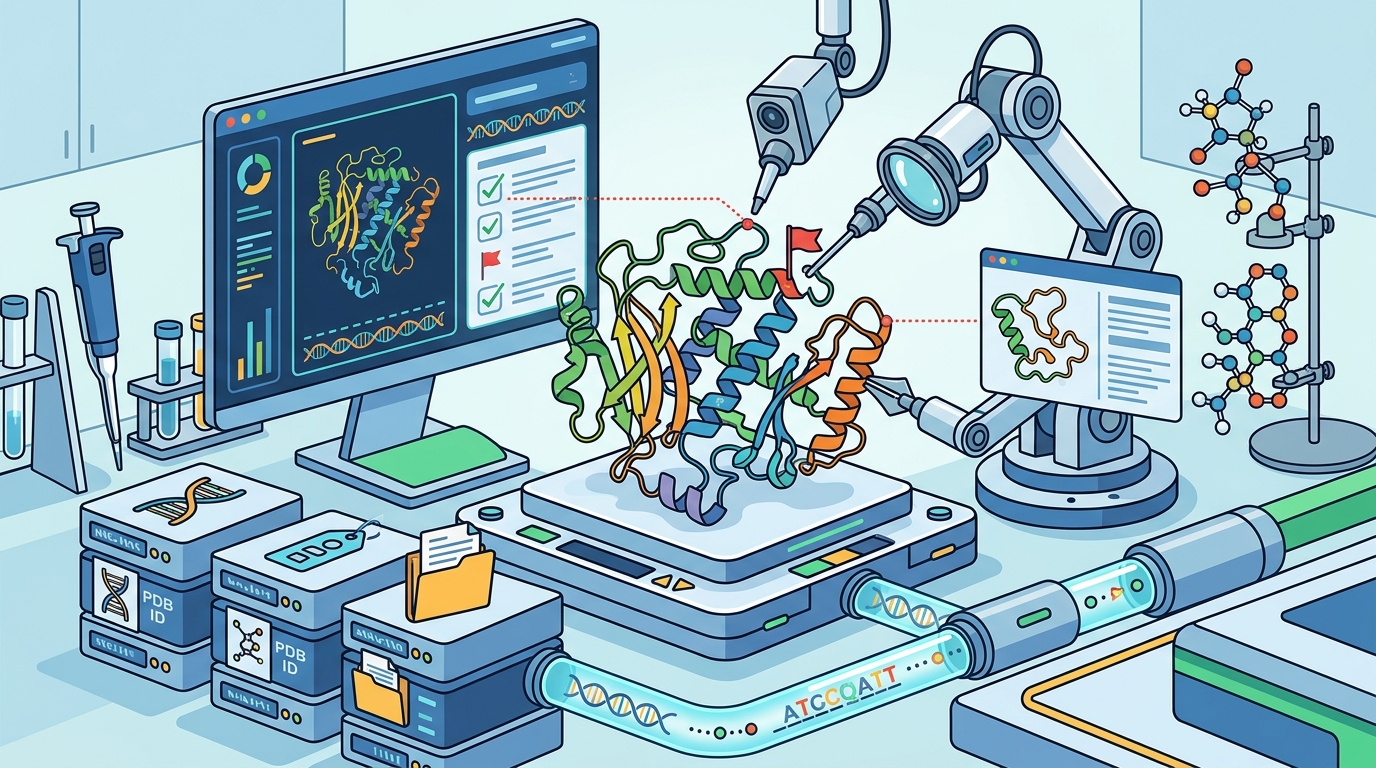
Automated Auditing of Mutation Labels
This audit is particularly useful for cancer gene families where multiple mutants are deposited. It separates true comparable mutants from same-sequence copies and wrong domains. By using this approach, researchers can ensure they are analyzing the correct protein variant.
Handling Complex Carbohydrate Structures
Incorrect labeling of carbohydrate residues can affect the interpretation of protein-ligand interactions. Therefore, auditing these labels is as important as auditing the protein backbone. Researchers should verify that all non-standard residues are correctly identified and labeled. according to pdb care PDB
Comparison of Validation Approaches
| Approach | Focus | Output | Best For |
|---|---|---|---|
| wwPDB Validation Report | Geometry and sequence vs UniProt | HTML/PDF report | Initial quality check |
| Label Audit | Undeclared mutations and chain identity | Flagged CSV | Deep structural auditing |
| Carbohydrate Check | Glycosylation site annotation | Annotation report | Glycoprotein structures |
Key Takeaways
- wwPDB validation reports are the first line of defense against structural errors.
- Sequence mismatches in validation reports require manual or automated context analysis.
- Undeclared mutations can significantly alter the interpretation of a structure.
- Automated label audits can identify discrepancies that are not obvious in the report.
- Carbohydrate residues must be audited separately from the protein backbone.
- Structural distance does not equal biological function or pathogenicity.
- Always verify flagged discrepancies against the original deposition paper.
Frequently Asked Questions
What is a wwPDB validation report?
A wwPDB validation report is a standardized document that assesses the quality of a deposited protein structure, including geometry and sequence integrity.
How do I check for undeclared mutations?
You can use automated tools to compare the deposited sequence against a reference and flag any differences not listed in the mutation labels.
Are all sequence mismatches errors?
No, some mismatches are intentional mutations or cloning artifacts. Context from the original paper is needed to determine if they are errors.
What is residue sequence labeling?
Residue sequence labeling is the assignment of specific amino acid identities to the coordinates in a PDB file, which must match the intended construct.
Why are carbohydrate labels important?
Carbohydrate labels are important because they affect the interpretation of protein-ligand interactions and glycosylation sites.
Can I use validation reports for clinical decisions?
No, validation reports and structural analyses are for research use only and must not be used for patient care decisions.
Conclusion
Verifying PDB structure labels is a critical step in structural biology research. By combining wwPDB validation reports with automated label audits, researchers can ensure the accuracy of their data. Morphogenesis Analytics provides the tools to perform these audits efficiently and accurately. Explore the Protein Structure Analyzer to start your own structural verification today.