

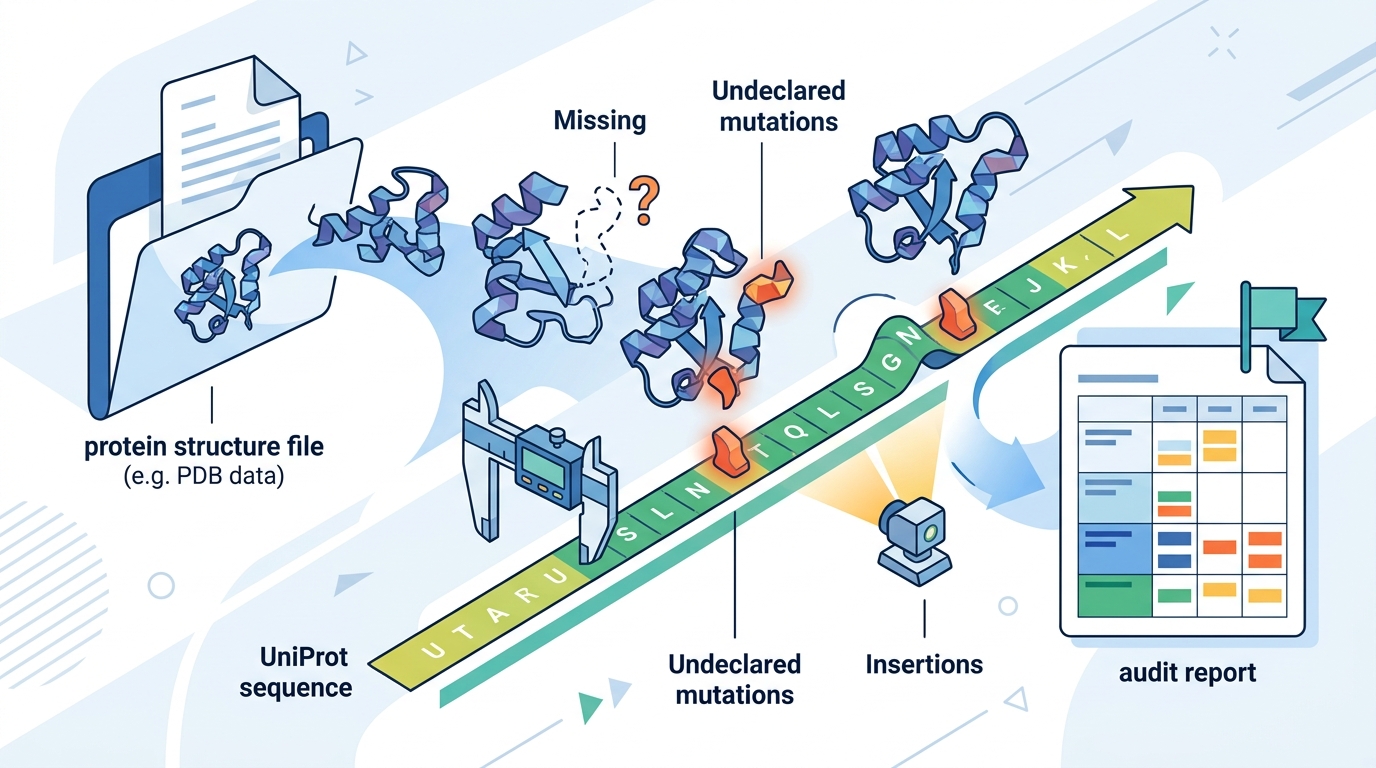
Verifying a protein structure file against the official UniProt sequence requires extracting the residue sequence from the 3D coordinates and aligning it to the canonical reference. This process identifies missing residues, insertions, and undeclared mutations. Morphogenesis Analytics automates this audit, flagging discrepancies between deposited labels and actual sequence data to ensure your structural data is accurate. For additional details, review the .
Why Sequence Verification Matters
Protein structure files often contain subtle errors that compromise downstream analysis. A single missing residue can shift the entire coordinate frame, while an undeclared mutation can invalidate functional interpretations. Sequence verification is the process of comparing the amino acid sequence derived from a 3D structure against a trusted reference database. This step is critical because structural databases like the Protein Data Bank (PDB) rely on depositor-provided metadata, which can sometimes be incomplete or incorrect. For additional details, review the Customer Experience.
For researchers working with cancer genes or drug targets, these discrepancies are not just technical nuisances. They can lead to false conclusions about binding sites or conformational changes. By establishing a baseline of sequence identity, you ensure that any structural differences you observe are due to biological state rather than data entry errors. according to AlphaFold Protein Structure For additional details, review the Frequently Asked Questions.
Understanding the UniProt Reference
UniProt is the universal protein knowledgebase, providing a comprehensive, high-quality, and freely accessible set of protein sequences annotated with functional information. When verifying a structure, you must select the correct UniProt entry. This is not always straightforward, as a single gene can produce multiple isoforms. The canonical sequence in UniProtKB/Swiss-Prot is manually reviewed and represents the most reliable reference point.
It is important to distinguish between the canonical sequence and the specific construct used in an experiment. A crystal structure might use a truncated version of the protein, lacking the N- or C-terminal regions. This is not an error, but it must be documented. UniProtKB is the curated section of the database where these high-quality annotations reside. Using the wrong isoform as a reference will result in false-positive mismatch flags.
Alignment Methods and Tools
Once you have both the structure sequence and the UniProt reference, you need to align them. Standard sequence alignment tools like BLAST can compare nucleotide or protein sequences to databases and calculate the statistical significance of matches. However, for structural verification, you need a local alignment that accounts for the specific boundaries of the deposited construct. according to Sequences UniProt help
Tools like BLAST are useful for initial identification, but they may not provide the residue-level detail needed for structural auditing. More specialized tools focus on the geometric context of the residues. For example, Gene3D provides a simple aggregate description of the data set, helping to identify domain boundaries. When aligning, look for gaps that correspond to disordered regions in the structure. These are common and expected, but they must be distinguished from true sequence deletions.
Interpreting Discrepancies and Mutations
When an alignment reveals differences, you must categorize them. Are they declared mutations, or are they undeclared? A declared mutation is one that the depositor has explicitly noted in the PDB entry. An undeclared mutation is a sequence difference that is not mentioned in the metadata. This is a critical distinction for reproducibility.
Mutation structural check is a specific type of analysis where a named substitution, such as KRAS G12D, is checked against every matching deposited structure. If the structure shows a different residue at that position, and it is not declared, the entry is flagged. This level of scrutiny is essential for building reliable datasets. It ensures that when you compare two structures, you are comparing the same biological entity.
Automated Audits with Morphogenesis Analytics
Manual verification is time-consuming and prone to human error. Morphogenesis Analytics offers a Protein Structure Analyzer that automates this process. The platform takes a gene or a list of PDB IDs and identifies which entries are the right protein, chain, and domain. It flags sequence differences that their mutation labels do not declare, delivering the results as a flagged CSV with residue-level evidence.
This automated approach scales to entire gene families. For a cancer gene, the platform measures every deposited structure against a reference, separating true comparable mutants from same-sequence copies and wrong domains. This family report provides a clear view of the structural landscape, highlighting entries that require further investigation.
Key Takeaways
- Always verify the sequence of a protein structure file against the canonical UniProt entry before using it for analysis.
- Distinguish between expected truncations (disordered regions) and true sequence deletions or mutations.
- Use curated UniProtKB/Swiss-Prot entries as your reference to ensure high-quality annotation.
- Undeclared mutations are a common source of error in structural databases and must be flagged.
- Automated tools can scale this verification process to entire gene families, saving significant time.
- Sequence identity is a prerequisite for valid structural comparison; without it, geometric differences are meaningless.
Frequently Asked Questions
What is the best reference database for protein sequence verification?
UniProt is the standard reference database. Specifically, the UniProtKB/Swiss-Prot section provides manually reviewed and annotated sequences, making it the most reliable source for verification.
How do I handle disordered regions in my structure file?
Disordered regions are common in crystal structures and NMR models. They should be treated as expected gaps in the alignment, not as sequence deletions. Ensure your alignment tool accounts for these regions.
Can I use BLAST for structural sequence verification?
BLAST is useful for initial identification and statistical significance, but it may lack the residue-level detail needed for precise structural auditing. Specialized tools are often better for this task. according to BLAST Basic Local
What is an undeclared mutation?
An undeclared mutation is a sequence difference between the structure file and the reference sequence that is not mentioned in the deposition metadata. These are critical to flag for data integrity.
How does Morphogenesis Analytics help with this process?
Morphogenesis Analytics automates the audit by comparing deposited structures against UniProt references, flagging undeclared mutations, and delivering residue-level evidence in a CSV format.
Conclusion
Verifying your protein structure files against UniProt is a fundamental step in ensuring data integrity. By using the right reference and alignment tools, you can identify and flag discrepancies that would otherwise compromise your analysis. Morphogenesis Analytics provides the automated infrastructure to perform these audits at scale, giving you the confidence that your structural data is accurate and reproducible. To start your audit, visit the Protein Structure Analyzer.