

7 Key Milestones and Metrics for Cancer Gene Structural Family Reports
Implementing a structural family report for a cancer gene requires tracking specific data quality and analytical milestones. These metrics ensure that every deposited structure is correctly identified, compared, and interpreted. Morphogenesis Analytics provides the computational framework to measure these outcomes accurately. This guide outlines the essential checkpoints for a robust structural survey. For additional details, review the .
1. Structure Identity and Label Audit Accuracy
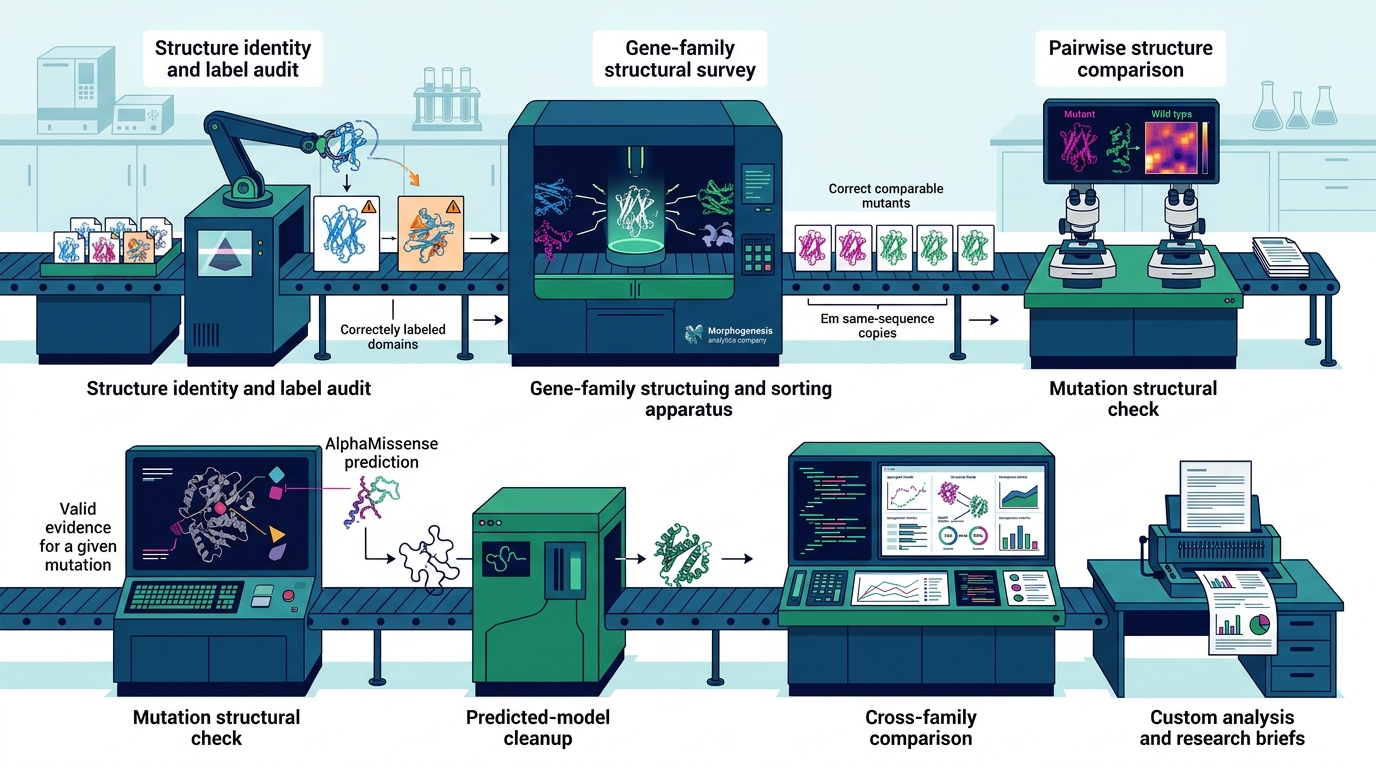
Verify that every PDB entry matches the intended protein, chain, and domain. A foundational metric is the percentage of structures that pass a strict identity audit. This process flags entries where the sequence differs from the declared mutation labels. It also identifies wrong domains or partner proteins that do not belong to the target gene family. High accuracy here prevents downstream errors in the entire report.
2. Reference Alignment and Sequence Identity
Measure the sequence identity of each structure against a canonical reference. This metric separates true comparable mutants from same-sequence copies. It ensures that the structural comparison is biologically relevant. Tracking the distribution of sequence identity helps identify outliers that may represent distinct isoforms or experimental artifacts. This step is critical for maintaining the integrity of the family-wide dataset.
3. Mutation Label Discrepancy Rate
Quantify the frequency of undeclared mutations or label mismatches. A key metric is the number of structures where the deposited mutation labels do not match the actual sequence differences. This discrepancy rate highlights data quality issues in public repositories. It is important to note that a flagged discrepancy is not a negative finding but a signal for further verification. Checking these against original depositions is a standard part of the audit workflow.
4. Structural Distance from Reference
Calculate the geometric difference between each structure and the reference model. Structural distance metrics describe the physical deviation in the protein fold. It is crucial to understand that this distance reflects geometric difference, not biological function. It does not indicate mutation impact, pathogenicity, or drug sensitivity. Differences can arise from conformational states, ligands, or binding partners. Tracking these distances helps map the structural landscape of the gene family.
5. Evidence Layer Separation
Ensure that geometry, sequence, and annotations are reported as distinct layers. A robust report separates different types of evidence to avoid misinterpretation. Geometry, sequence identity, deposited mutation labels, and pathogenicity annotations are distinct kinds of evidence. They must be reported separately to maintain clarity. This separation allows researchers to weigh the evidence appropriately for their specific questions.
6. Third-Party Prediction Integration
7. Long-Term Data Stability and Reproducibility
Choosing the Right Metrics
Select metrics based on your specific research goals. If your focus is on data quality, prioritize identity and label audit accuracy. If your goal is to understand structural variation, focus on structural distance and evidence layer separation. A balanced approach tracks all seven milestones to ensure a comprehensive and reliable report.
Frequently Asked Questions
What is a structural family report?
A structural family report is a comprehensive analysis of all deposited structures for a specific cancer gene, measured against a reference model.
How is structural distance calculated?
Structural distance is calculated by measuring the geometric difference between a structure and a reference model, typically using per-residue displacement.
Does structural distance indicate pathogenicity?
No, structural distance describes geometric difference only. It does not indicate biological function, mutation impact, pathogenicity, or drug sensitivity.
Are AlphaMissense scores generated by the platform?
No, AlphaMissense scores are third-party predictions. They are included as a separate layer and are not generated by the platform.
What should I do if a mutation label discrepancy is flagged?
A flagged label discrepancy should be checked against the original deposition. It is not a negative finding but a signal for further verification.
Conclusion
Tracking these seven milestones ensures that your cancer gene structural family report is accurate, reproducible, and scientifically robust. Morphogenesis Analytics provides the tools to measure these metrics effectively. To begin your structural survey, visit the Protein Structure Analyzer.