

What Happens to Protein Structure When You Swap a Single Amino Acid?
Swapping a single amino acid in a protein sequence can trigger local geometric shifts, alter secondary structure stability, or leave the overall fold unchanged. The outcome depends on the specific residue, its position within the three-dimensional structure, and the local chemical environment. Morphogenesis Analytics provides computational tools to measure these geometric differences precisely, allowing researchers to quantify structural changes without assuming biological impact. according to Binary patterning of For additional details, review the .
Local Geometric Shifts and Side Chain Dynamics
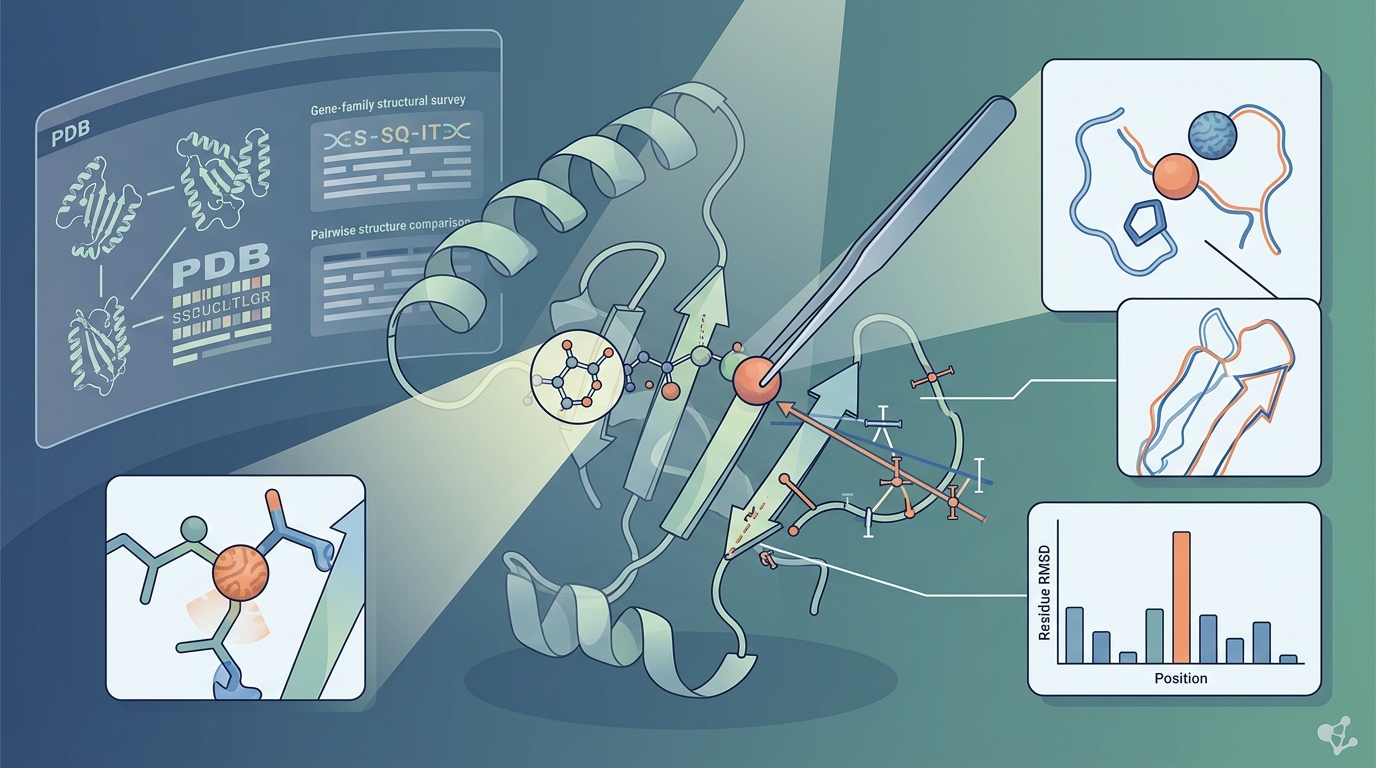
When a single amino acid is substituted, the most immediate effect is often a local geometric shift in the side chain and its immediate neighbors. The primary sequence of a protein largely dictates the ensemble of secondary structures, which work in concert with environmental factors to modulate a protein's biological functions. Amino acids are molecules that combine to form proteins, and their specific R groups determine how they pack within the hydrophobic core or interact with the solvent. For example, replacing a small glycine with a bulky tryptophan can force the backbone to adjust its phi and psi angles to accommodate the larger side chain. This local steric clash can propagate a few angstroms into the surrounding residues, altering the local density map.
Impact on Secondary Structure and Hydrogen Bonding
Substitutions can also disrupt or stabilize secondary structure elements like alpha helices and beta sheets. The local environment of an amino acid in a folded protein determines the acceptability of mutations at that position. Amino acid networks, where amino acids are represented by nodes that are connected if they are within a distance threshold, have been used to model protein structure and predict how a single change might break a critical hydrogen bond. For instance, swapping a polar asparagine for a nonpolar leucine in a beta sheet can remove a key hydrogen bond donor, potentially destabilizing the sheet. This change in local polarity can shift the equilibrium between folded and unfolded states, even if the overall topology remains similar.
Long-Range Allosteric Effects and Domain Stability
While local effects are common, some single amino acid swaps trigger long-range allosteric changes that affect distant parts of the protein. Quaternary structure is the association between 2 or more polypeptides, but not every protein has a quaternary structure, yet even monomeric proteins can undergo domain-wide rearrangements. A mutation in one domain can alter the flexibility of a linker region, causing a shift in the relative orientation of another domain. This is particularly relevant in multi-domain proteins where the interface between domains is sensitive to subtle changes in packing. Understanding these long-range effects requires comparing the full three-dimensional structure, not just the local neighborhood of the mutation.
Measuring Structural Differences Computationally
To quantify these changes, researchers use computational tools that align and compare mutant and wildtype structures region by region. Morphogenesis Analytics offers a pairwise structure comparison service that measures per-residue displacement between two structures of the same protein. This approach separates true structural changes from artifacts caused by different crystal packing or ligand binding. The platform also provides a mutation structural check, which compares a named substitution against every matching deposited structure, ensuring that the observed changes are consistent across multiple experimental datasets. By using these tools, researchers can distinguish between geometric differences and biological function, as structural distance from a reference describes geometric difference, not biological impact. according to protein structures visual
Key Takeaways
- Single amino acid swaps can cause local steric clashes that alter backbone geometry.
- Changes in polarity can disrupt hydrogen bonding networks in secondary structures.
- Long-range allosteric effects can shift domain orientation in multi-domain proteins.
- Computational alignment tools are essential for quantifying per-residue displacement.
- Geometric differences do not automatically imply changes in biological function.
- Comparing multiple deposited structures helps filter out experimental artifacts.
Frequently Asked Questions
Does a single amino acid change always alter protein structure?
No, not always. Some substitutions are conservative and result in minimal geometric changes, while others can cause significant local or long-range structural shifts.
How do I measure the structural impact of a mutation?
You can use computational tools that align mutant and wildtype structures and calculate per-residue displacement to quantify the geometric changes.
Can a mutation in one domain affect another domain?
Yes, long-range allosteric effects can cause shifts in the relative orientation of distant domains, especially in multi-domain proteins.
What is the difference between geometric change and functional change?
Geometric change refers to the physical displacement of atoms, while functional change refers to alterations in biological activity. They are related but not identical.
How can I verify if a structural change is real or an artifact?
Comparing multiple deposited structures of the same mutation helps distinguish true structural changes from artifacts caused by crystal packing or ligand binding.
Conclusion
Understanding the structural consequences of single amino acid swaps is critical for interpreting mutation data in structural biology. By using precise computational tools, researchers can move beyond qualitative descriptions and quantify the exact geometric changes that occur. Morphogenesis Analytics provides the infrastructure to perform these detailed comparisons, ensuring that your analysis is grounded in rigorous structural data. To explore how a specific mutation affects your protein of interest, visit the Morphogenesis Analytics platform. according to Linking protein structural