

What signs should I look for when checking if a PDB structure has hidden mutations?
Sequence Identity Mismatches
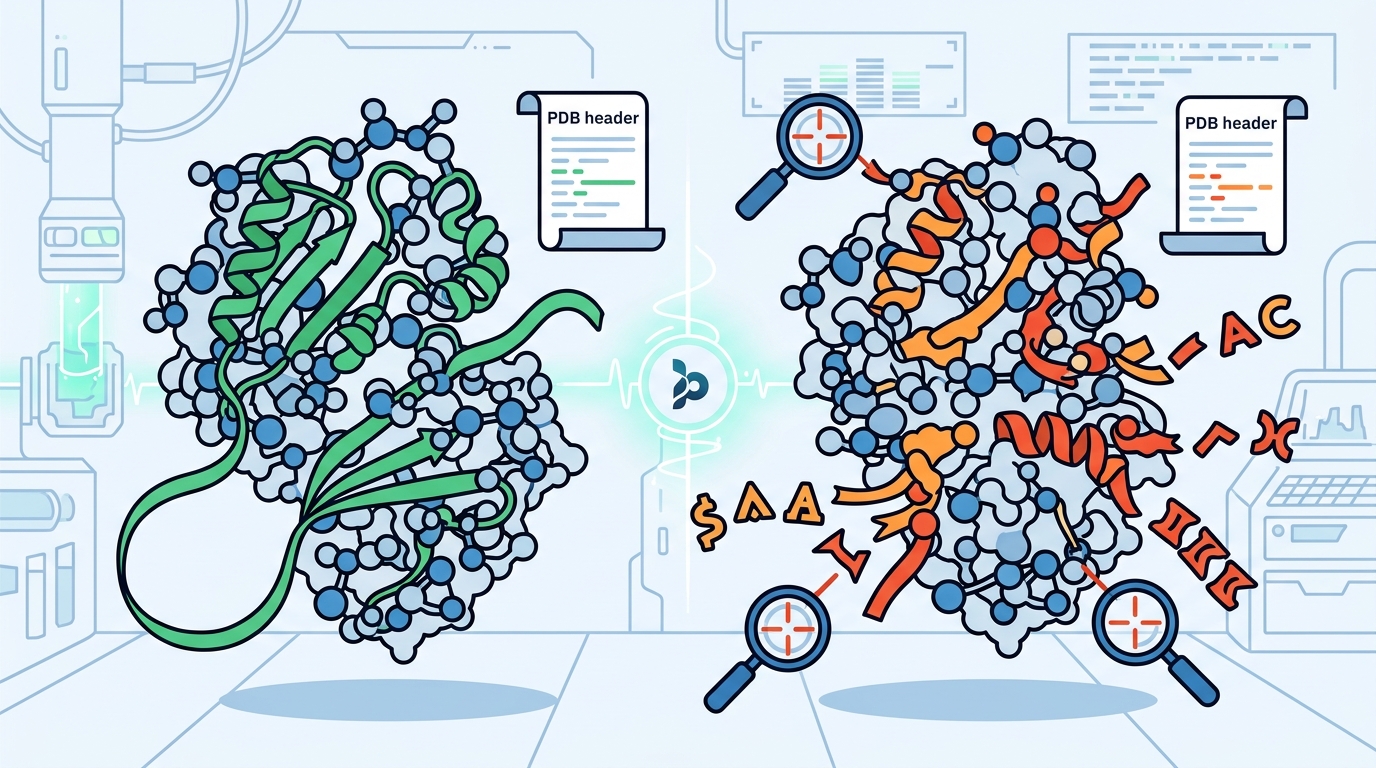
The most direct sign of a hidden mutation is a mismatch between the sequence declared in the PDB header and the sequence implied by the deposited coordinates. When a structure is deposited, the authors declare specific mutations in the header. However, the actual atomic model may contain additional substitutions that were not listed. Sequence identity mismatch is a discrepancy between the declared mutation list and the actual amino acid substitutions present in the deposited structure. For example, a structure labeled as wild-type might actually contain a silent mutation or a non-conservative substitution that was not declared. This can happen when the construct used for crystallization differs from the one described in the paper, or when mutations are introduced for expression purposes but not reported in the structural context. Researchers should always verify the sequence identity by aligning the deposited sequence against the reference wild-type sequence. If the alignment reveals substitutions that are not in the mutation list, these are potential hidden mutations. These discrepancies can significantly alter the interpretation of the structure, especially if the hidden mutation affects a functionally important site. according to A global analysis For additional details, review the Customer Experience.
Geometric Deviations and Conformational States
Another sign of a hidden mutation is unusual geometric deviation in the protein backbone or side chains. Geometric deviation is a measure of the spatial difference between a deposited structure and a reference structure, often calculated as per-residue displacement. While some deviations are due to conformational changes or ligand binding, others may indicate a mutation that alters the local structure. For instance, a bulky side chain might cause steric clashes or shift the backbone if a mutation is present but not declared. Researchers can look for regions with high root-mean-square deviation (RMSD) compared to a reference structure. If these regions correspond to residues that are not declared as mutated, it may suggest a hidden substitution. However, it is important to note that geometric differences can also arise from conformational states, construct differences, or binding partners. Therefore, geometric analysis should be combined with sequence verification to accurately identify hidden mutations. according to Geometric standard deviation For additional details, review the Frequently Asked Questions.
Label Discrepancies and Deposition Errors
Using Computational Tools for Verification
Computational tools can automate the process of identifying hidden mutations by comparing deposited structures against reference sequences and mutation labels. Morphogenesis Analytics offers a protein structure analyzer that performs a structure identity and label audit. This tool takes a gene or a list of PDB IDs and identifies which entries are the right protein, chain, and domain, and which have sequence differences their mutation labels do not declare. The results are delivered as a flagged CSV with residue-level evidence. This allows researchers to quickly identify potential hidden mutations and verify them against the original deposition. The tool also separates true comparable mutants from same-sequence copies, wrong domains, and partner proteins, ensuring that the analysis is accurate and relevant. By using such computational tools, researchers can save time and reduce the risk of misinterpreting structures due to hidden mutations. according to RCSB PDB 3K0R For additional details, review the About.
Implications for Structural Biology Research
Hidden mutations can have significant implications for structural biology research, particularly in the study of disease-related proteins. If a structure contains a hidden mutation that affects a functionally important site, it may lead to incorrect conclusions about the protein's mechanism or drug binding. For example, a hidden mutation in a kinase active site might alter the binding mode of a drug, leading to inaccurate structure-based drug design. Therefore, it is crucial to verify the sequence identity and mutation labels of all structures used in research. Researchers should also consider the context of the structure, including the construct, ligands, and binding partners, when interpreting geometric deviations. By carefully checking for hidden mutations, researchers can ensure that their structural analyses are accurate and reliable. This is especially important in the field of cancer biology, where mutations play a critical role in disease progression and treatment. according to A global analysis
Key Takeaways
- Sequence identity mismatches are a primary sign of hidden mutations in PDB entries.
- Geometric deviations can indicate hidden mutations but may also result from conformational changes.
- Label discrepancies occur when declared mutation labels do not match the actual sequence or structure.
- Computational tools like Morphogenesis Analytics can automate the verification of structural identities.
- Hidden mutations can significantly impact the interpretation of structural data and drug binding.
- Researchers should always verify sequence identity and mutation labels before using a structure in their work. according to R Percent Sequence
- Checking against the original deposition is essential when a label discrepancy is flagged.
Frequently Asked Questions
What is a hidden mutation in a PDB structure?
A hidden mutation is an amino acid substitution present in the deposited structure that is not declared in the mutation labels of the PDB entry.
How can I detect a hidden mutation in a PDB entry?
You can detect a hidden mutation by comparing the deposited sequence against the reference wild-type sequence and checking for discrepancies with the declared mutation labels.
Do geometric deviations always indicate a hidden mutation?
No, geometric deviations can also result from conformational changes, construct differences, or binding partners. They should be interpreted in conjunction with sequence verification.
What is a label discrepancy in a PDB entry?
Can computational tools help identify hidden mutations?
Yes, computational tools can automate the process of comparing deposited structures against reference sequences and mutation labels to identify potential hidden mutations.
Why are hidden mutations important in structural biology?
Hidden mutations can alter the interpretation of a structure, especially if they affect functionally important sites, leading to incorrect conclusions about protein mechanism or drug binding.
What should I do if I find a label discrepancy in a PDB entry?
You should check the original deposition details and compare them with the associated publication to verify the discrepancy before concluding the entry is wrong.
Conclusion
Identifying hidden mutations in PDB structures is a critical step in ensuring the accuracy of structural biology research. By checking for sequence identity mismatches, geometric deviations, and label discrepancies, researchers can avoid misinterpreting structures and drawing incorrect conclusions. Morphogenesis Analytics provides powerful computational tools to automate this verification process, offering residue-level evidence for any undeclared differences. To ensure your structural analyses are robust and reliable, use the Protein Structure Analyzer to audit your PDB entries and flag any potential hidden mutations. according to RCSB PDB 3K0R