

What do PDB validation reports actually tell you about protein structure quality and errors?
Core Metrics and Their Limitations
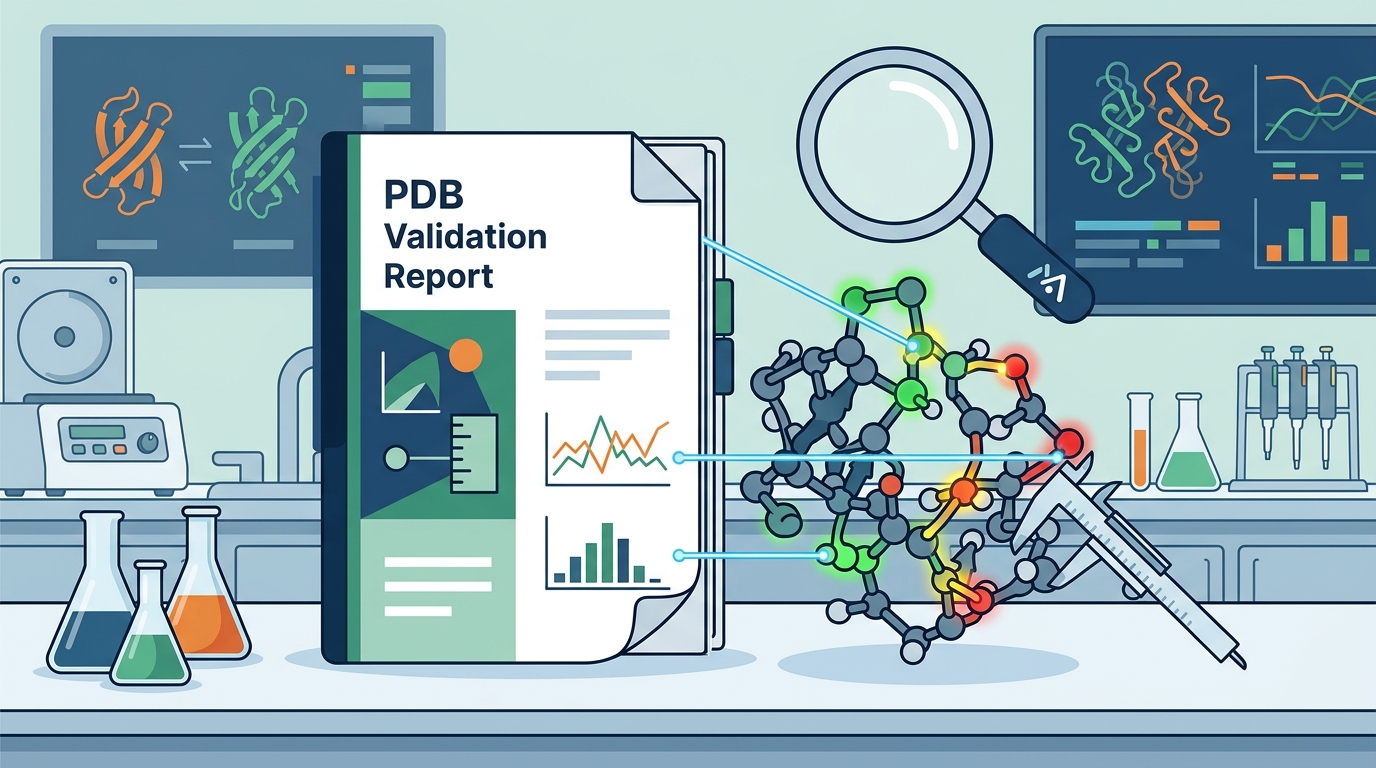
Structure validation is the process of comparing model coordinates against experimental data and chemical standards. The Worldwide Protein Data Bank (wwPDB) generates these reports to highlight specific concerns in the model. These metrics are essential for quality control but have strict boundaries. For additional details, review the Customer Experience.
The wwPDB Validation Pipeline
The wwPDB validation pipeline is a standardized system for assessing structure quality using widely accepted criteria. The RCSB PDB, as a founding member of the wwPDB, curates and annotates data according to these global standards. This ensures consistency across the entire archive. For additional details, review the Frequently Asked Questions.
When a structure is deposited, the system runs automated checks on the coordinates. It evaluates the fit of the model to the electron density maps for X-ray structures. For NMR and cryo-EM structures, different validation reports are generated to match the specific data types. These reports provide percentile statistics that compare a specific entry against the rest of the archive.
Ligand Geometry and Chemical Quality
Ligand structure quality is a critical component of the validation report. The wwPDB validation report provides validation of individual ligand quality using RMSZ scores for bond lengths and angles. These scores indicate how well the ligand geometry matches known chemical standards.
High RMSZ scores can indicate errors in the ligand model or issues with the experimental data. Researchers must check these metrics to ensure that drug-binding sites are modeled correctly. A ligand that fits the density but has poor geometry may suggest a modeling error rather than a true biological interaction. according to RCSB PDB 1GLI
Identity Audits and Sequence Discrepancies
Validation reports check geometry, but they do not always verify that the deposited sequence matches the declared mutation labels. Morphogenesis Analytics performs identity audits to find entries where the sequence differs from the declared mutation. This is a common source of error in structural biology.
For example, a structure labeled as a specific mutant might actually contain the wild-type sequence. Geometric validation will not flag this because the structure is physically valid. Only a sequence-level audit can detect this discrepancy. This distinction is vital for researchers building datasets for machine learning or drug design. according to Access Structure Quality
Practical Implications for Research
Understanding what validation reports do and do not tell you is essential for rigorous research. A high-quality validation report confirms that the structure is geometrically sound. It does not confirm that the protein is in its native biological state. Differences in structure can arise from conformational changes, ligand binding, or construct variations.
Researchers should treat validation reports as a baseline for geometric integrity. They should then use additional tools to verify sequence identity and biological context. This multi-layered approach ensures that the data used for analysis is both structurally valid and biologically accurate.
Key Takeaways
- Structure validation is the process of comparing model coordinates against experimental data and chemical standards.
- The wwPDB validation pipeline provides standardized metrics for assessing structure quality across the global archive.
- Ligand structure quality is measured using RMSZ scores for bond lengths and angles to detect geometric errors.
- Validation reports confirm geometric plausibility but do not verify sequence identity or biological function.
- Sequence discrepancies, such as undeclared mutations, require specific identity audits to detect.
- Researchers should combine geometric validation with sequence-level checks for comprehensive data quality assurance. according to The Protein Model
Frequently Asked Questions
What is a PDB validation report?
A PDB validation report is a standardized assessment of a protein structure's geometric and chemical quality. It is generated by the wwPDB to highlight potential errors in the deposited model.
Do validation reports confirm biological function?
No, validation reports do not confirm biological function. They assess geometric plausibility and chemical standards, not pathogenicity or drug sensitivity.
What does an RMSZ score indicate?
An RMSZ score indicates how well the ligand geometry matches known chemical standards. High scores suggest potential errors in the ligand model or experimental data.
Can validation reports detect sequence errors?
Validation reports primarily check geometry, not sequence identity. Specific identity audits are required to detect undeclared mutations or sequence discrepancies.
Who generates wwPDB validation reports?
The wwPDB partners, including the RCSB PDB, generate validation reports. These reports use widely accepted standards and criteria to assess structure quality.
How often are validation reports updated?
What is the difference between geometric and sequence validation?
Geometric validation checks the physical plausibility of the structure. Sequence validation checks that the deposited sequence matches the declared labels and reference sequences.
Conclusion
PDB validation reports are essential tools for ensuring the geometric integrity of structural data. They provide a standardized way to assess model quality across the global archive. However, they are not a complete picture of structural accuracy. Morphogenesis Analytics helps researchers go beyond basic validation by auditing sequence identity and flagging undeclared differences. This ensures that your structural data is both geometrically sound and biologically accurate.