

Computational biology students often struggle to translate raw structural data into actionable biological insights. Morphogenesis Analytics provides a specialized environment where learners can audit protein structures, compare mutants, and validate model predictions. By working with real deposited data, students develop durable analytical habits that extend far beyond a single course project. For additional details, review the .
1. Structural Identity and Label Auditing
Students learn to verify that a deposited structure matches its declared biological identity. The platform allows users to input a gene or list of PDB IDs to identify the correct protein, chain, and domain. This process trains students to detect sequence differences that mutation labels might fail to declare. They gain the ability to produce flagged CSVs with residue-level evidence, a critical skill for data curation.
2. Gene-Family Structural Surveying
Learners master the separation of true comparable mutants from irrelevant structural copies. When analyzing a cancer gene, students measure every deposited structure against a reference. They learn to distinguish same-sequence copies, wrong domains, and partner proteins from genuine variants. This builds a deep understanding of structural diversity within a gene family, delivered through family report PDFs and full data tables.
3. Pairwise Region-by-Region Comparison
Students develop the precision to compare two structures of the same protein at the residue level. Whether comparing a mutant to a wildtype or two drug-bound states, the platform provides per-residue displacement data. This teaches students to interpret geometric changes in specific regions rather than relying on global metrics. The resulting comparison reports train them to articulate structural differences with high specificity.
4. Mutation Structural Validation
Learners gain the ability to cross-reference named substitutions against deposited structural evidence. A substitution like KRAS G12D is checked against every matching deposited structure. The platform displays AlphaMissense scores as a separate layer, teaching students to distinguish third-party predictions from direct geometric evidence. This dual-layer approach reinforces the importance of independent verification in computational analysis.
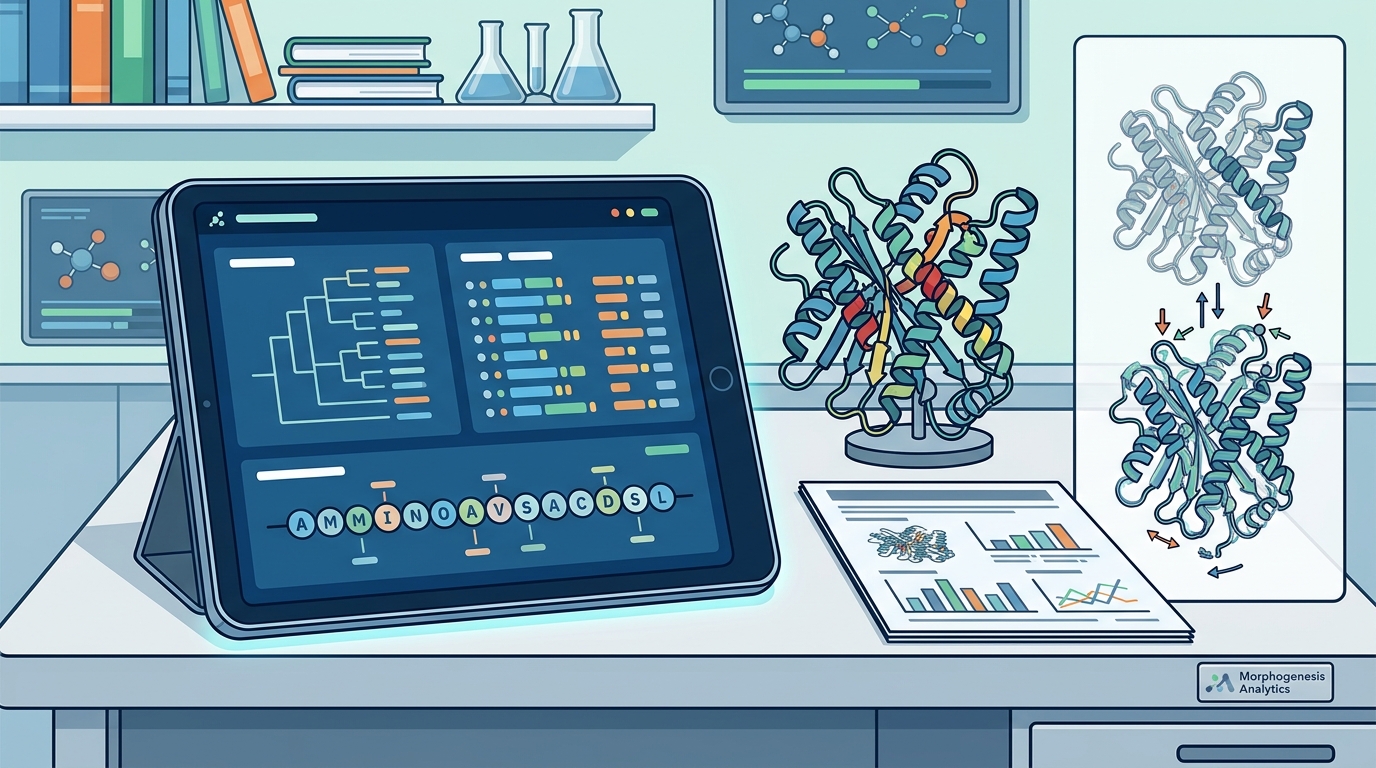
5. Predicted-Model Cleanup and Regularization
6. Cross-Family Aggregate Analysis
Learners acquire the ability to compare structural variation across multiple cancer gene families. Instead of analyzing one gene in isolation, students generate aggregate reports that highlight patterns across families. This broadens their perspective on how structural variation manifests in different biological contexts. It prepares them for complex, multi-target research questions that require a comparative approach.
Choosing the Right Analysis for Your Goals
Select the analysis module that matches your specific research question. Use identity audits for data curation, pairwise comparisons for detailed mechanistic studies, and cross-family reports for broad pattern recognition. Each module builds a distinct layer of computational expertise that compounds over time.
Frequently Asked Questions
Does using this platform replace traditional structural biology coursework?
No, it complements coursework by providing a practical environment for applying theoretical concepts to real data. Students still need foundational knowledge to interpret the results generated by the platform.
Can students use the results for academic publications?
Yes, provided they follow standard academic integrity guidelines and verify the data independently. The platform is a research tool, not a source of truth, so independent verification is always required.
How does the platform handle missing data or undeclared mutations?
Missing data or undeclared mutations are flagged as discrepancies rather than negative findings. Students are trained to check these flags against original depositions before drawing conclusions.
Is the platform suitable for beginners in computational biology?
Yes, the structured workflows guide beginners through complex analyses step by step. The clear separation of evidence layers helps new users understand the nature of the data they are processing.
What is the long-term career value of these skills?
These skills are highly transferable to roles in biotech, pharma, and academic research. The ability to audit, compare, and refine structural data is a core competency in modern computational biology. according to 7 In Demand
Start Building Your Structural Analysis Skills
Ready to apply these skills to real data? Explore the Protein Structure Analyzer to begin your analysis today.