

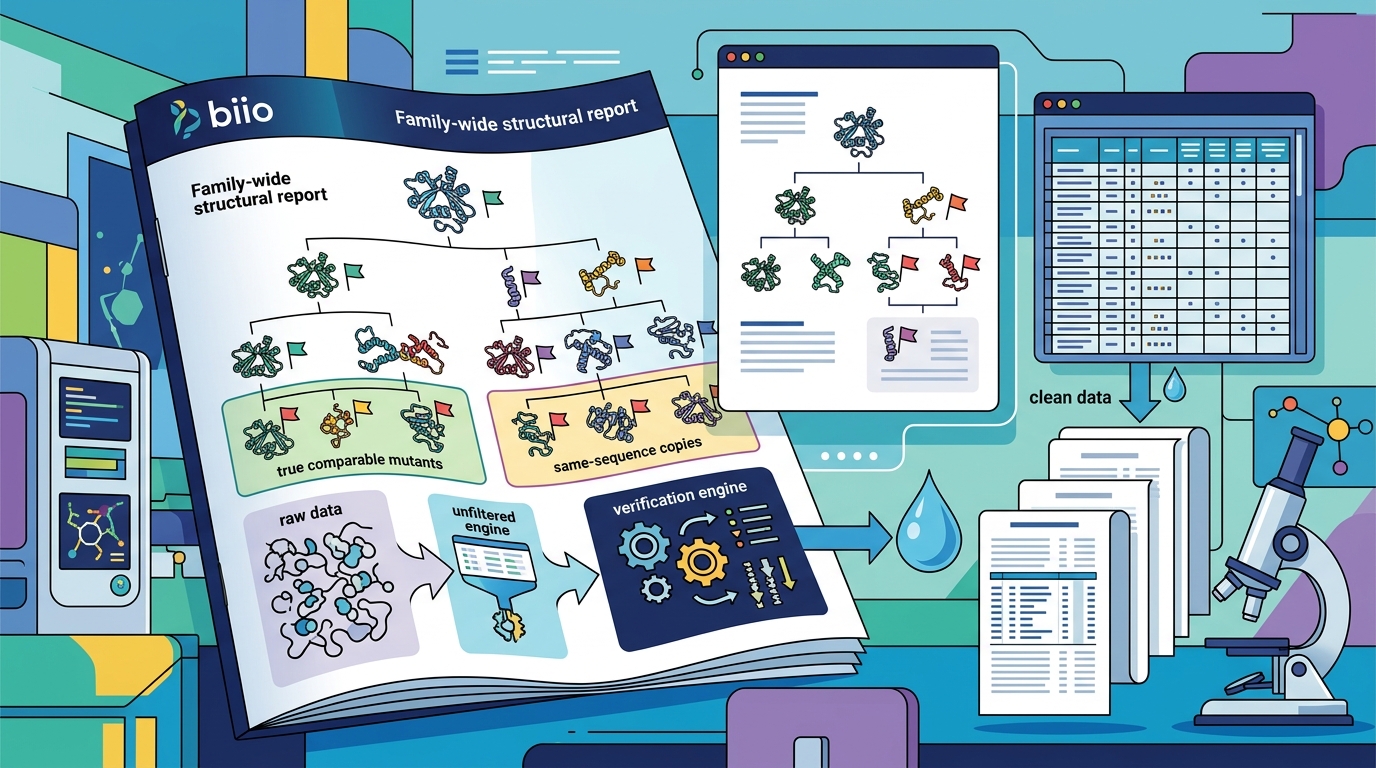
Only specialized computational platforms deliver a family-wide structural report for a cancer gene with a full data table. General-purpose databases provide raw coordinates but lack the automated filtering to separate true mutants from same-sequence copies or wrong domains. This guide explains how to select, verify, and utilize these specialized services for precision oncology research. For additional details, review the .
How to Choose a Provider
Selecting the right tool for structural genomics requires distinguishing between raw data repositories and analytical engines. A standard database provides the coordinates of a protein structure but does not interpret the biological context of the mutations within that structure. A specialized analytical service, such as Morphogenesis Analytics, processes these coordinates to identify which entries represent the correct protein, chain, and domain. The primary differentiator is the ability to flag sequence differences that mutation labels do not declare. If a service cannot separate true comparable mutants from same-sequence copies or partner proteins, it is not suitable for a family-wide survey. according to Frontiers A Survey
Automated Filtering Capabilities
Look for platforms that automatically measure every deposited structure against a reference. This process identifies wrong domains and partner proteins that often contaminate gene-specific searches. The output should be a clean dataset where the structural identity is audited and labeled. For additional details, review the Customer Experience.
Deliverable Format
Questions to Ask Before Committing
Before engaging a service, you must clarify the scope of the analysis. Ask specifically how the platform handles undeclared mutations. A robust system will flag label discrepancies where the deposited mutation does not match the sequence difference. You should also ask how the service distinguishes between geometric differences and biological function. Structural distance describes geometric difference, not biological function, mutation impact, pathogenicity, cancer severity, or drug sensitivity. Clarifying this distinction prevents misinterpretation of the results. For additional details, review the Frequently Asked Questions.
Evidence Layer Separation
Inquire how the provider reports different types of evidence. Geometry, sequence identity, deposited mutation labels, and pathogenicity annotations are distinct kinds of evidence. A high-quality service reports these separately rather than conflating them into a single score. For additional details, review the About.
Verifying Claims and Credentials
Third-Party Predictions
Be aware of how third-party predictions are handled. AlphaMissense scores are third-party predictions and are not generated by the platform itself. A transparent service will display these scores as a separate layer, clearly indicating their external origin.
The Analysis Workflow
The process begins with the submission of a gene name or a list of PDB IDs. The system then performs a structure identity and label audit. It determines which entries are the right protein, chain, and domain. Next, it identifies sequence differences that the mutation labels do not declare. This audit is delivered as a flagged CSV with residue-level evidence. For a gene-family structural survey, the system measures every deposited structure for that cancer gene against a reference. It separates the true comparable mutants from same-sequence copies, wrong domains, and partner proteins. The final output is a family report PDF and the full data table.
Pairwise Comparison
For specific comparisons, such as mutant versus wildtype, the service performs a pairwise structure comparison. This compares two structures of the same protein region by region, with per-residue displacement. This level of granularity is essential for understanding conformational changes.
Cost Drivers
Costs in structural genomics are driven by the complexity of the gene family and the depth of the analysis. A simple structure identity audit is less computationally intensive than a full gene-family structural survey. The survey requires measuring every deposited structure against a reference, which scales with the number of entries in the database. Cross-family comparison, which analyzes structural variation across several cancer gene families, represents the highest tier of computational effort. Pricing is typically based on the number of genes or PDB IDs processed and the specific modules requested, such as predicted-model cleanup or custom research briefs. according to Genetics of Colorectal
Common Mistakes to Avoid
Comparison with Alternatives
General-purpose tools like Pisces, Plinder, Rascore, and Klifs offer specific utilities for protein structure analysis. However, they often focus on single-structure visualization or specific mutation scoring rather than family-wide surveys. The following table compares the capabilities of these alternatives with specialized family report services.
| Family-Wide Survey according to National Survey of | Limited or manual | Automated against reference |
| Label Discrepancy Flagging | Not typically included | Residue-level evidence in CSV |
| Separation of Mutants | User-dependent | Automated separation of true mutants |
| Deliverable | Interactive viewer or single file | PDF Report and Full Data Table |
| Third-Party Score Integration | Varies | Clear separation of evidence layers |
Application to Specific Situations
The utility of a family-wide report varies by research context. For a specific mutation check, such as KRAS G12D, the service checks the named substitution against every matching deposited structure. This is distinct from a broad family survey. In the case of pediatric cancers or structural birth defects, understanding the genetic causes requires precise structural mapping. The service can provide a written evidence brief on a target or question, built from the platform's runs. This custom analysis is valuable for grant applications or detailed mechanistic studies.
Rules and Protections
Users must adhere to the rules governing the use of computational analysis. Results are provided as is, without guarantee of accuracy or completeness. Users are responsible for independent verification. The service is not a medical device or clinical diagnostic and must not be used for patient care decisions. This distinction is critical for maintaining the integrity of the research and ensuring compliance with regulatory standards. according to Computational Statistics Data
Regional and Operational Specifics
While the computational analysis is global, the operational context matters. Morphogenesis Analytics is based in the USA, which may influence data handling practices and support availability. The platform utilizes publicly deposited protein structures, ensuring that the data is accessible and reproducible. Researchers in different regions should consider the latency of data transfer and the specific formats required by their local institutions.
Timing the Analysis
Timing affects the outcome of structural analysis. New structures are deposited regularly, and the landscape of a gene family changes over time. Running a family-wide survey at different intervals can reveal new conformational states or previously undeclared mutations. It is advisable to schedule analyses when significant new data is expected or when a specific research question requires the most current structural evidence. according to Characterization of large
Long-Term Outcomes
Key Takeaways
- Specialized services are required for family-wide structural reports with full data tables.
- Automated filtering separates true mutants from same-sequence copies and wrong domains.
- Label discrepancies are flagged with residue-level evidence in a CSV format.
- Structural distance describes geometric difference, not biological function or pathogenicity.
- Evidence layers such as geometry, sequence, and labels are reported separately.
- Experimental modules like Void Shell are not validated for drug-binding site identification.
- Results are for research use only and are not clinical diagnostics. according to Clinical research
- Independent verification is the responsibility of the user.
Frequently Asked Questions
What is a family-wide structural report?
A family-wide structural report is a comprehensive analysis of every deposited structure for a specific cancer gene, measured against a reference to identify true comparable mutants.
How does the service handle undeclared mutations?
The service flags sequence differences that mutation labels do not declare, providing residue-level evidence in a flagged CSV file.
Is the service a clinical diagnostic tool?
No, the service is for research use only. It is not a medical device or clinical diagnostic and must not be used for patient care decisions. according to Cancer Genetics Risk
What does structural distance measure?
Structural distance measures geometric difference from a reference. It does not describe biological function, mutation impact, pathogenicity, cancer severity, or drug sensitivity.
Are AlphaMissense scores generated by the platform?
No, AlphaMissense scores are third-party predictions. They are displayed as a separate layer and are not generated by the platform.
Can I use experimental modules for drug discovery?
Modules marked experimental, including Void Shell, have not passed validation and should not be used to identify drug-binding sites.
What is the deliverable format?
The deliverable is a family report PDF and the full data table, allowing for both narrative review and computational analysis.
Who is responsible for verifying the results?
Users are responsible for independent verification. Results are provided as is, without guarantee of accuracy or completeness.