

Comparing PDB Sequences to UniProt: A Practical Guide
Yes, specialized bioinformatics tools can compare a deposited PDB file's real sequence against UniProt reference sequences. Morphogenesis Analytics provides a Protein Structure Analyzer that performs this exact audit, identifying sequence differences and mutation label discrepancies. This guide covers the core comparison tools, the mechanics of PDB to UniProt alignment, and the critical steps for structure file validation in structural biology workflows.
Sequence Comparison Tools
Sequence comparison is the foundational step in verifying structural data. A sequence comparison tool is a software utility that aligns biological sequences to identify similarities, differences, and evolutionary relationships. Researchers often rely on these tools to ensure that the sequence deposited in a structural file matches the canonical reference sequence. according to Frontiers Comparison of
The Role of BLAST
The Basic Local Alignment Search Tool (BLAST) is the industry standard for this task. The program compares nucleotide or protein sequences to sequence databases and calculates the statistical significance of matches, as described by the NCBI BLAST documentation. For protein structures, BLAST allows users to query a PDB sequence against the UniProt database to find the closest matching reference entry.
Specialized Structural Auditing
General alignment tools often miss subtle issues specific to structural biology. Morphogenesis Analytics addresses this by offering a structure identity and label audit. This service takes a gene or a list of PDB IDs and identifies which entries are the correct protein, chain, and domain. It specifically flags sequence differences that mutation labels do not declare, delivering the results as a flagged CSV with residue-level evidence.
Quality Control in High-Throughput Data
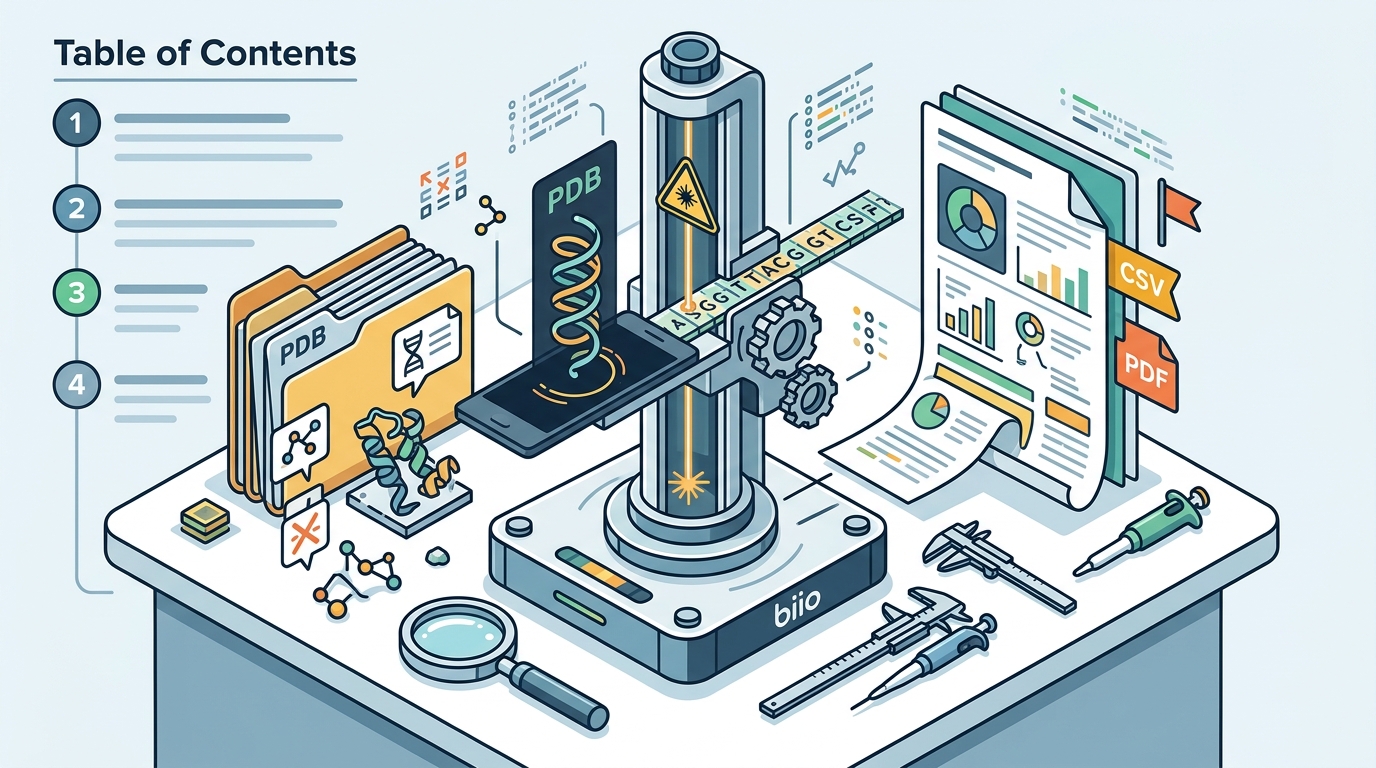
PDB UniProt Alignment
Aligning a PDB file to UniProt is more complex than a simple text comparison. PDB files contain experimental coordinates, while UniProt provides canonical biological sequences. The alignment process must account for missing residues, disordered loops, and construct variations.
Understanding the Data Sources
The Protein Data Bank (PDB) and UniProt serve different purposes. The RCSB PDB curates and annotates PDB data according to agreed upon standards, providing a variety of tools and resources for the community, as noted in the RCSB PDB documentation. UniProt, conversely, focuses on functional and sequence information. Aligning these two requires mapping the experimental sequence to the reference sequence while preserving residue numbering.
Handling Sequence Discrepancies
Discrepancies between PDB and UniProt sequences are common. These can arise from point mutations, truncations, or the inclusion of expression tags. A pairwise structure alignment tool, such as the one available at RCSB PDB, can help visualize these differences. However, visual inspection is often insufficient for large-scale validation. Automated alignment is necessary to detect subtle mismatches that may indicate labeling errors.
The Importance of Reference Selection
Selecting the correct UniProt reference is critical. There are a large number of predicted Refseq transcripts in the Refseq mRNA, Refseq RNA and nr database, which can complicate reference selection, according to the NCBI Primer-BLAST tool. Choosing the wrong isoform or variant can lead to false positives in sequence comparison. Morphogenesis Analytics mitigates this risk by measuring every deposited structure against a reference, separating true comparable mutants from same-sequence copies and wrong domains.
Structure File Validation
Label and Mutation Auditing
One of the most common errors in structural databases is the mismatch between the deposited sequence and the declared mutation labels. A mutation structural check, such as the one offered by Morphogenesis Analytics, checks a named substitution like KRAS G12D against every matching deposited structure. This ensures that the residue at the specified position actually matches the declared mutation.
Geometric Consistency
Interpreting Validation Results
It is important to understand what validation results mean. Structural distance from a reference describes geometric difference, not biological function, mutation impact, pathogenicity, cancer severity or drug sensitivity. Differences can arise from conformational state, construct, ligands or binding partners. Therefore, a flagged discrepancy should be checked against the original deposition before concluding the entry is wrong. Geometry, sequence identity, deposited mutation labels and pathogenicity annotations are distinct kinds of evidence and are reported separately. according to Cross validation statistics
Key Takeaways
- Sequence comparison tools like BLAST are essential for initial alignment of PDB sequences against UniProt references.
- PDB UniProt alignment requires careful handling of missing residues, disordered loops, and construct variations.
- Mutation label discrepancies are a common issue in structural databases and require automated detection.
- Specialized tools like the Morphogenesis Analytics Protein Structure Analyzer provide residue-level evidence for sequence and label audits.
- Structural distance metrics describe geometric differences, not biological function or pathogenicity.
- Quality control tools for high-throughput data are increasingly important as structural databases grow.
- Validating structures against multiple evidence layers, including geometry and sequence identity, ensures data integrity.
Frequently Asked Questions
What is the best tool for comparing PDB sequences to UniProt?
BLAST is the standard for general sequence comparison, but specialized tools like the Morphogenesis Analytics Protein Structure Analyzer are better suited for structural auditing. These tools provide residue-level evidence and flag mutation label discrepancies that general alignment tools may miss.
How does PDB UniProt alignment handle missing residues?
PDB UniProt alignment accounts for missing residues by mapping the experimental sequence to the reference sequence while preserving residue numbering. Disordered loops and truncated regions are handled by aligning the available residues and noting the gaps. This ensures that the alignment reflects the actual deposited structure.
What is structure file validation?
Can I use BLAST to validate mutation labels in PDB files?
What does structural distance from a reference mean?
Structural distance from a reference describes geometric difference, not biological function, mutation impact, pathogenicity, cancer severity or drug sensitivity. It is a measure of how much the structure deviates from the reference in terms of atomic positions.
How do I choose the correct UniProt reference for alignment?
Choosing the correct UniProt reference requires understanding the specific isoform or variant of the protein in the PDB file. There are a large number of predicted Refseq transcripts in the Refseq mRNA, Refseq RNA and nr database, which can complicate this choice. Automated tools can help by measuring every deposited structure against a reference and separating true comparable mutants from same-sequence copies.
Is AlphaMissense generated by Morphogenesis Analytics?
No, AlphaMissense scores are third-party predictions and are not generated by this platform. They are shown alongside as a separate layer in mutation structural checks to provide additional context.
What is the difference between sequence identity and structural distance?
Sequence identity measures the percentage of matching residues between two sequences, while structural distance measures the geometric difference between two structures. These are distinct kinds of evidence and are reported separately in validation reports.